Wild elephants may have domesticated themselves, a process that has only been previously identified in bonobos and humans, a new study suggests.
For thousands of years, people have domesticated, or bred other animals such as dogs and horses to enhance their friendliness, reduce aggression and increase cooperation. Some scientists think a similar phenomenon called self-domestication has given humans and bonobos (Pan paniscus) traits commonly found in domestic animals. During self-domestication, individuals who are less aggressive and more cooperative are more likely to successfully breed and pass on their genes. However, experts told Live Science that the underlying idea of "self-domestication" doesn't really hold water.
In the new study, Limor Raviv, who studies the evolution of languages at the Max Planck Institute for Psycholinguistics in the Netherlands, and her colleagues suggest that elephants have also domesticated themselves. The findings were published Apr. 3 in the journal Proceedings of the National Academy of Sciences.
The scientists compared wild African elephants from the species Loxodonta africana with bonobos and humans on 19 social, cognitive and physical traits. The researchers found that elephants, like bonobos and humans, are not very aggressive, play a lot, have a long childhood — reaching adolescence at 10 to 20 years old — and babysit each other's offspring. They also found that elephants, like bonobos and humans, have relatively short jawbones, a trait commonly seen in other domesticated animals and which is thought to be a byproduct of selecting for other traits during domestication.
By comparing the genome of wild African savannah elephants with those of 261 domesticated mammals such as dogs, cats and horses, the scientists identified 79 genes linked to domestication in other species that seem to have become more common in elephant generations over time.
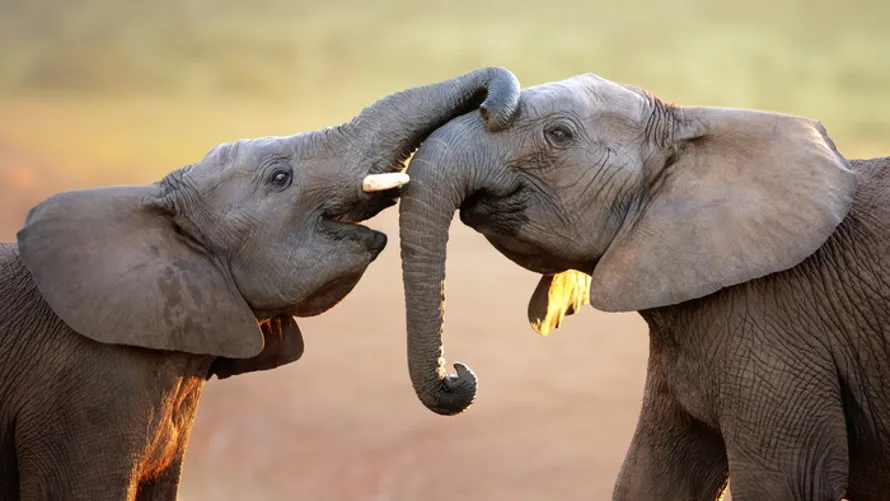
Adult elephant tending to a younger elephant.
(Image credit: Pieter Ras via Getty Images)
The findings suggest that elephants have been self-domesticated, the scientists wrote in their paper. One factor driving this self-domestication could be the "massive size and relative strength" of elephants, because they are "less worried about evading or fighting other animals for their survival," the researchers wrote in their paper. This could allow the gentle giants to "free cognitive resources and open up opportunities for exploration, communication, and play," the team wrote.
Sign up for the Live Science daily newsletter now
Get the world’s most fascinating discoveries delivered straight to your inbox.
But other experts aren't sold on the concept.
"It's a fun idea but I'm certainly not convinced by self-domestication as a concept," Dominic Wright, an evolutionary biologist who studies domestication at Linköping University in Sweden, told Live Science. "I certainly agree that humans have evolved to have increased sociality and increased communication but I don't think you need to bring in this term of self-domestication for humans or elephants." The term is unnecessary as it doesn’t help us understand how animal domestication or evolution of social behavior occurs, Wright said.
What's more, the genetic evidence in the study is weak, said Wright, who was not involved in the research.
"They link genes in elephants with genetic pathways thought to be involved in the domestication of other animals but that doesn't really tell us if those genes actually contribute to them having traits associated with domestication, they may have any other function."
"I would personally not use the concept of self-domestication, but that's more like a semantic issue," Per Jensen, a geneticist studying animal domestication at Linköping University in Sweden, who was not involved in the study, told Live Science.
Still, the study presents an "interesting idea" that helps "trigger new thoughts on how increased cooperativeness and reduced aggression has evolved," which could ultimately help us find ways to reduce aggression in humans, Jensen said.
Carissa Wong is a freelance reporter who holds a PhD in cancer immunology from Cardiff University, in collaboration with the University of Bristol. She was formerly a staff writer at New Scientist magazine covering health, environment, technology, nature and ancient life, and has also written for MailOnline.