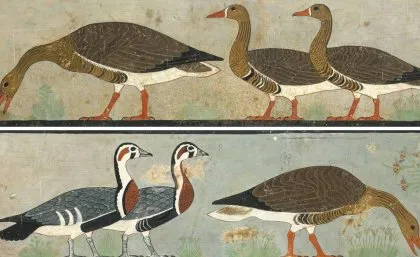
Nearly five millennia ago, an artist inked an incredibly detailed painting of geese in the tomb of an Egyptian vizier and his wife. This "Mona Lisa" of ancient Egypt may depict a previously unknown and now extinct species of goose, a new analysis suggests.
The 4,600-year-old painting, known as "Meidum Geese," was discovered in the 1800s in the tomb of Nefermaat, a vizier, or the highest-ranking official who served the pharaoh (and was likely also his son) and his wife Itet in Meidum, an archaeological site in lower Egypt, according to the Metropolitan Museum of Art in New York City. The painting was discovered in the Chapel of Itet inside the tomb.
The vivid painting, which was once part of a larger tableau that also depicted men trapping birds in a net as offerings for the tomb owner, has since been described as "Egypt's Mona Lisa," study author Anthony Romilio, a technical assistant at The University of Queensland's school of chemistry and molecular biosciences in Australia, said in a statement. But "apparently no one realized it depicted an unknown species."
Last year, while examining the painting, which is now in Cario's Museum of Egyptian Antiquities, one illustrated goose caught Romilio's eye, according to the statement. The colors and patterns of the bird looked very different from modern geese.
"Artistic license could account for the differences with modern geese, but artworks from this site have extremely realistic depictions of other birds and mammals," he said. So why wouldn't this goose be accurately depicted?
The ancient goose in the painting (left) is most similar to a red-breasted goose (Branta ruficollis) but has major differences as can be seen in the comparison of a reconstructed version (middle) with the red-breasted goose (right).
(Image credit: CK Wilkinson, A. Romilio, Tambako the Jaguar)
In the study, Romilio took measurements of the three species of geese depicted, including the colors and body markings used to illustrate it, with modern geese. He found that one species of goose in the painting resembled the modern greylag goose (Anser anser) but could have also been a bean goose (A. fabalis), a second resembled the greater white-fronted goose (A. albifrons), but the third didn't match up to any modern waterfowl.
Sign up for the Live Science daily newsletter now
Get the world’s most fascinating discoveries delivered straight to your inbox.
The mysterious goose is most similar to a red-breasted goose (Branta ruficollis) but with a few key differences in color patterns on its body and face, according to the statement.
Still, because the other birds were accurately represented, it's unclear if this third goose type is truly an extinct species, or a misrepresentation of a surviving species. It's also possible the long-lost painter used artistic license, and that the oddball goose is a complete "fabrication," according to the study.
No bones from modern red-breasted geese have been found in any Egyptian archeological site, but bones belonging to an unidentified bird similar to this red-breasted bird were found in Crete, Romilio said in the statement.
Egypt was once a biodiversity hotspot when it was covered in lush grasslands, lakes and woodlands, he said. Many of these ancient species — which are now extinct — were depicted in artwork decorating tombs and temples.
"Art provides cultural insight, but also a valuable, graphical record of animals unknown today," Romilio said. Past paintings have led researchers to discover unknown species of gazelle, oryx, antelope, donkey and tauroch, or the predecessor to the modern cow, he said. "These ancient animal representations help us recognize the biodiversity thousands of years ago that coexisted with humans."
Yasemin is a staff writer at Live Science, covering health, neuroscience and biology. Her work has appeared in Scientific American, Science and the San Jose Mercury News. She has a bachelor's degree in biomedical engineering from the University of Connecticut and a graduate certificate in science communication from the University of California, Santa Cruz.