














Newfound Frog Species Threatened by Deadly Fungus

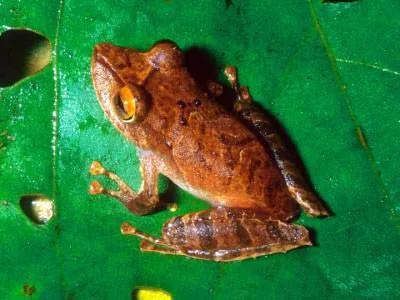
Two previously unknown frog species have been identified from two sites in Panama, and they are already under threat from the deadly fungus that has wiped out many amphibian species and is poised to threaten many more.
Researchers recognized that frogs (and other amphibians) around the world were dying off in large numbers in 1989. The cause: a deadly fungus called chytridiomycosis that is thought to kill its victims by clogging their skin, essentially suffocating them.
The fungus has rolled across Central America in a seemingly unstoppable wave, killing countless frogs and wiping out an estimated 100 species. Many of the areas affected are virtually pristine habitats little visited by humans with untold numbers of species not known to science, many of which have or will die off before ever being identified.
Researchers make trips to areas that have not yet been hit by the fungal epidemic to study the healthy ecosystems and document the species before they are gone.
"If we know this is a wave of death, we can get ahead of the wave," said herpetologist Karen Lips of the University of Maryland in College Park, who has studied frogs in the area and the fungus attacking them for many years.
Rescue trips to take samples of frogs back to zoos and other institutions in the United States and elsewhere to save species have also been mounted.
"We are working as hard as we can to find and identify frogs before the disease reaches them, and to learn about a disease that has the power to ravage an entire group of organisms," said Roberto Ibanez, a research scientist at the Smithsonian Tropical Research Institute and the local director of the Panama Amphibian Rescue and Conservation Project.
Get the world’s most fascinating discoveries delivered straight to your inbox.
Funny feet
While working at a healthy site in Panama's Omar Torrijos National Park several years ago, Lips and her team noticed a common frog that looked much bigger than specimens of its species collected elsewhere. The researchers suspected the frog could be a different species from the group it had previously been lumped in with, but it was also possible that frogs of the known species were simply bigger at this site than elsewhere.
To figure out whether the frog was its own species, members of Lips' team looked at other aspects of the frog, such as its feet and toe pads and found that it had round finger disks and toes that distinguish it from other, closely related species. It was "a bunch of little things," Lips said, that showed this frog was its own species, which researchers named Pristimantis educatoris.
In 2004, the chytrid fungus finally showed up at the site where the new species had been discovered. Lips told LiveScience that many of the frogs were likely wiped out, but that the species had been found in other spots and some individuals seemed to be hanging on in infected areas.
There are also likely many undiscovered species at the spot where the new frog was found that have not been described yet.
"This one is really just the tip of the iceberg," she said.
DNA does it
The other new species was found during a trip to Panama's Darien Province, near the Colombian border. That frog, named Pristimantis adnus, was only distinguished as a new species through its DNA. (The frog's name is based on the acronym for the Spanish word for deoxyribonucleic acid, or DNA, which is acido deoxiribonucleico, or ADN.)
"We chose this name to underscore the usefulness of genetic techniques as we identify these new frog species and determine the relationships between tropical frogs that may look very similar," said Andrew Crawford of STRI and the University of the Andes, who was a member of the team that discovered the second new species.
These two new discoveries bring the total number of frogs described in Panama and Costa Rica to 197. Nearly 15 percent of these frogs have been described in the past seven years.
The description of P. educatoris is detailed in the June issue of the Journal of Herpetology, and the discovery of P. adnus is described in the June issue of the journal Herpetologica.
- 10 Species You Can Kiss Goodbye
- Images: Snakes, Frogs and Lizards
- Video – Disappearing Frogs

Andrea Thompson is an associate editor at Scientific American, where she covers sustainability, energy and the environment. Prior to that, she was a senior writer covering climate science at Climate Central and a reporter and editor at Live Science, where she primarily covered Earth science and the environment. She holds a graduate degree in science health and environmental reporting from New York University, as well as a bachelor of science and and masters of science in atmospheric chemistry from the Georgia Institute of Technology.