













How an Eggbeater Could Power the Future

Editor's Note: Each Wednesday LiveScience examines the viability of emerging energy technologies — the power of the future.
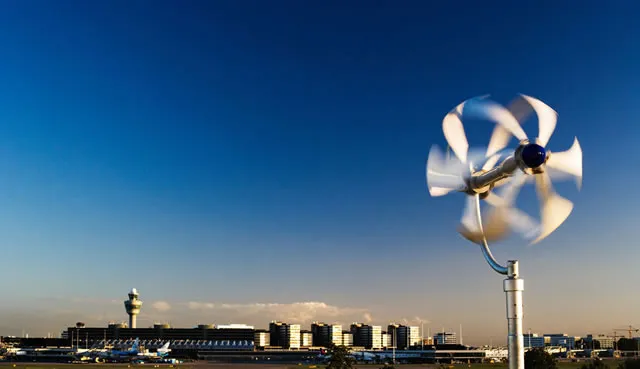
From Holland, the country famous for its windmills, comes a new design for home wind power. Looking like an eggbeater, it spins quieter and at lower wind speeds than a lot of traditional propeller-type turbines. It's now standard for big wind turbines to have propeller blades. Much of the turning force is generated at the tips, which slice perpendicularly through the air, causing a swooshing noise that some residents nearby have said they find unnerving. By contrast, the so-called Energy Ball, sold by Dutch-based Home Energy International, has rotors bent around in a ball shape so that they primarily move parallel to the wind. This generates less noise. "A small wind turbine has to be silent, otherwise it will be annoying to the community," said Erik Aurik, Home Energy's marketing manager. The noise from an Energy Ball is always less than the sound of the wind, Aurik told LiveScience. And what's more, the device continues to work even when the wind speed dips down to as slow as 4.5 mph (2 meters per second), whereas the average turbine needs roughly twice that wind speed to turn. Venturi effect This is not the first wind turbine to resemble an egg-beater. The Darrieus wind turbine has a similar shape and has been around for almost 80 years. What's different with the Energy Ball is that it has a horizontal axis, not a vertical one. And it uses a different kind of physics, called the Venturi effect. The Venturi effect is characterized by a low pressure that occurs when a flow of air or liquid speeds up as it is constricted. Some perfume bottles use the Venturi effect to suck up perfume into the spray nozzle. The Energy Ball's design constricts the wind, thereby causing the pressure to drop inside the ball. This sucks in air flowing around the ball and helps turn the rotor blades. Because of this sucking action, Venturi-based turbines use more of the wind — and can therefore be 40 percent more efficient — than a propeller-style turbine of the same diameter, according to research by Technical University of Delft in Holland. Decorative windmills Energy Balls currently are sold in sizes of either 1 meter or 2 meters in diameter. They can be installed on a pole or a flat roof in as few as four hours, Aurik said. In places where the wind is relatively strong — blowing 15 mph, or 7 meters per second, on average — a 1-meter ball can generate up to 500 kilowatt-hours per year, while the 2-meter ball can supply 1,750 kilowatt-hours per year. The typical U.S. household uses 11,000 kilowatt-hours per year, so additional electricity will have to come from somewhere. However, these are optimum values that assume the small turbine is mounted at least 40 feet (12 meters) above the ground and is free from surrounding trees and buildings that block the wind. The cost of the Energy Ball is between $3,500 and $7,000, not including installation. "There is a lot of interest worldwide," Aurik said. "Everybody likes the design. It looks like an art piece."
- Top 10 Emerging Environmental Technologies
- Innovations: Ideas and Technologies of the Future
- First U.S. Town Powered Completely By Wind
Get the world’s most fascinating discoveries delivered straight to your inbox.
