













Electronics Industry Turns 100 Today

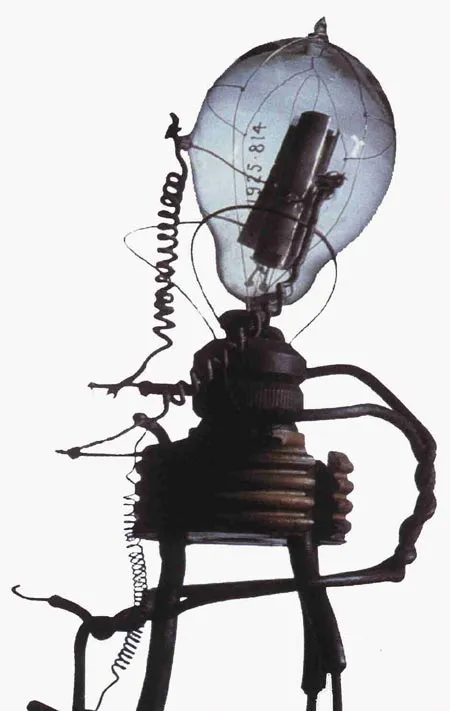
The frenetic, here-today-gone-tomorrow world of electronics, with all its iPods, cell phones, and other wild gizmos, turns 100 years old today.
Many scientists and engineers consider the birth of electronics to be Nov. 16, 1904, when John Ambrose Fleming applied for a British patent for his invention: the thermionic diode.
Arguably the first practical electronic device, the diode was a simple vacuum tube that converted alternating current (AC) to direct current (DC). An analogy would be leveling a series of hills and valleys into a flat plain. This had application in the early development of radio communications.
At a meeting of the AVS Science and Technology Society this week, one session will be devoted to celebrating Fleming's seminal invention and the plethora of electronics it spawned.
Fleming called his device an oscillation valve, but it has also been referred to as a thermionic valve, vacuum diode, and a Fleming valve.
It was made of two electrodes in an evacuated glass tube. Electrons flowing into one of the electrodes caused it to heat up. Some electrons essentially became so excited that they jumped off the surface of the one electrode and flew through the vacuum to the other electrode.
Modifications to this simple setup allowed these "jumping" electrons to induce other electrons to flow to the receiving electrode. This sort of amplification led to radios and TVs. Huge computers were later developed out of vast arrays of vacuum tubes.
Get the world’s most fascinating discoveries delivered straight to your inbox.
Transistors eventually replaced the tubes. There were still "jumping" electrons in these devices, but instead of a vacuum, there were different layers of semiconductor materials. Rapidly improving techniques have allowed transistors to shrink down to microscopic scales.
The progeny of the thermionic diode now live in everything that keeps our fast-paced electronic lives moving.
A short history of electronics
1880: Thomas Edison observes the "Edison effect" - electrons boiling off of a heated filament. He files a patent on the effect but does not use it for any practical purpose.
1895: Guglielmo Marconi sends and receives first radio signals.
1904: John Ambrose Fleming uses the Edison effect to make his thermionic diode.
1907: Lee DeForest places a wire grid between Fleming's two electrodes to make an amplifier, called a triode.
1948: William Bradford Shockley, John Bardeen and Walter Houser Brattain improve on the vacuum tube with their invention of the transistor, for which they shared the 1956 Nobel Physics prize.
1954: The first transistor radio is produced.
1959: Jack St. Clair Kilby and Robert Noyce separately develop the integrated circuit, which incorporated - on one semiconductor chip - all the transistors, resistors and capacitors that make an electronic device work.
1971: Federico Faggin, Ted Hoff, and Stan Mazor, working for the company Intel, design the first microprocessor, which basically continued along the line of the integrated circuit by placing all the brains and memory of a computer onto a single chip.
