















Colliding Galaxies Swirl in Dazzling New Photo

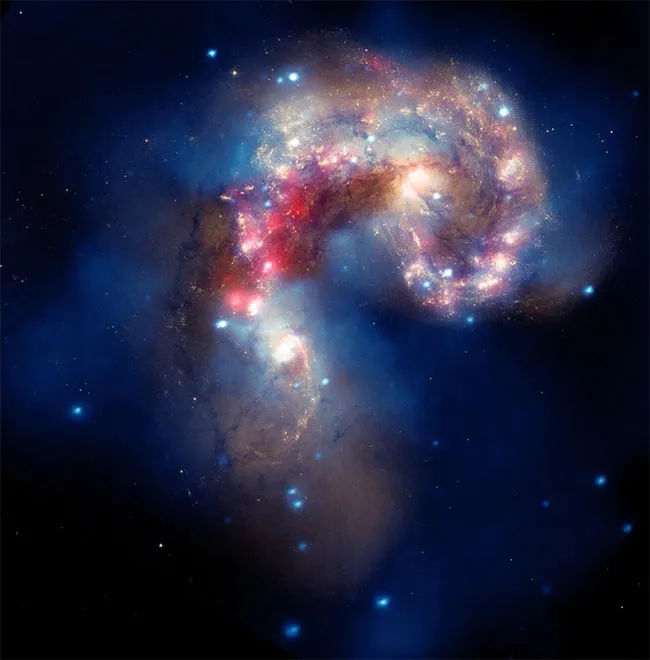
A spectacular new image of two colliding galaxies shows a cosmic region teeming with stellar activity.
The cosmic smash-up, which began more than 100 million years ago but is still occurring, has triggered the formation of millions of stars in the clouds of dust and gas within the galaxies. The composite image was created using data from several different space telescopes. [Photo of the galactic spectacle.]
The most massive of these young stars speed through their evolution in only a few million years, dying a violent stellar death in supernova explosions.
The colliding Antennae galaxies are located about 62 million light-years away from Earth. In addition to the photo, NASA also released a video of the galaxy collision using the same data from the Chandra X-ray Observatory (blue), the Hubble Space Telescope (gold), and the Spitzer Space Telescope (red).
The X-ray image from Chandra shows vast clouds of hot, interstellar gas that are injected with rich deposits of elements, such as oxygen, iron, magnesium and silicon, created in supernova explosions. The enriched gas will be incorporated into new generations of young stars and planets.
The Antennae galaxies get their name from the long, wispy antenna-like "arms" that can be detected in wide-angle views of the system. These appendage features were produced by tidal forces that were generated from the cosmic collision.
The bright, point-like sources in the image are produced by material that is falling onto black holes and neutron stars, which are dead relics of massive stars. Some of the black holes in the Antennae galaxies may contain masses that are almost one hundred times that of the sun.
Get the world’s most fascinating discoveries delivered straight to your inbox.
The data from the Spitzer telescope show infrared light from warm clouds of dust that have been heated by newly-formed stars, with the brightest clouds lying in the overlap region between the two colliding galaxies.
The Hubble data reveal old stars and star-forming regions in gold and white, while dusty filaments appear in brown. In the optical image, many of the fainter objects denote clusters containing thousands of stars.
The Chandra image was taken in Dec. 1999, the Spitzer image was taken in Dec. 2003, and the Hubble image was taken in July 2004 and Feb. 2005. Data from the three observatories were combined to make the new composite image, which was released Thursday.
