















Massive China Sandstorm Seen from Space

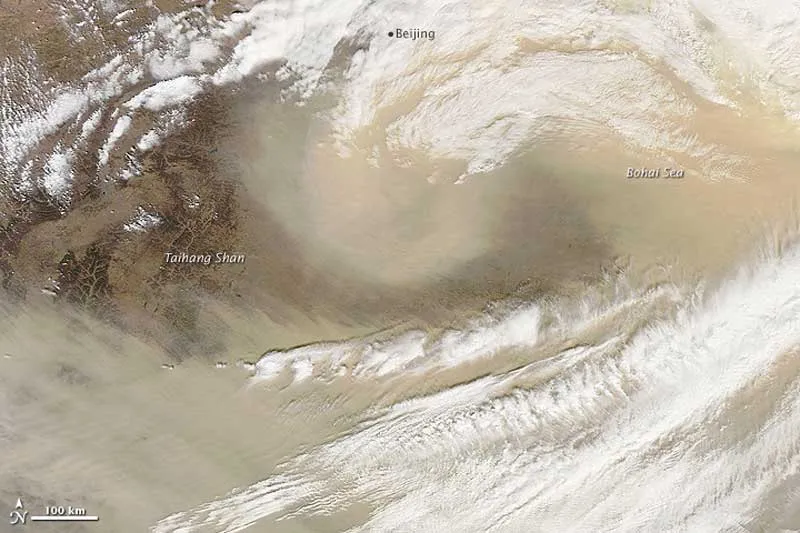
A massive sand and dust storm in China over the weekend has been imaged from space, revealing a shape much like a weather front.
The nasty storm kicked up sand and dust from the arid terrain of Inner Mongolia and swept it thousands of miles to the south and east. The yellow dust reduced visibility and air quality in Beijing and even as far away as Taiwan and Japan. Residents wore dust masks to combat the sandstorm.
The new satellite image shows the storm on Saturday, March 20.
Dust covers the lower half of the image and wraps around the right-hand side in a comma shape that ends in a large ball of sand and dust near image center. That's just what a cold weather front bearing a strong area of low pressure at the surface would look like, NASA explained in a statement.
These weird weather systems, known as mid-latitude cyclones, are often associated with giant comma-shaped clouds that reveal how air from a very wide area gets drawn in toward the low-pressure heart of the storm. Scientists say desertification of the region is to blame for one of the worst storms in modern memory.
Scientists have recognized in recent years that dust storms have global impact. Desert-dust storms whip up and disperse an estimated 2.4 billion tons of soil and dried sediment throughout the Earth's atmosphere annually.
During the African dust storm season, which runs May to October, strong winds in the Sahara Desert kick up major clouds of dust that can drift across the Atlantic Ocean in just a few days. Some of the dust settles in the ocean, but a large amount dumps on the Caribbean islands and the southeastern United States, rendering sunrises and sunsets redder than normal.
Get the world’s most fascinating discoveries delivered straight to your inbox.
Traces of African dust have been discovered as far west as New Mexico. The western states are also the recipients of dust that's been stirred up in China's deserts and blown across the Pacific.
One study showed that dust clouds blowing across the Atlantic Ocean carry hidden pathogens that might reach the United States.
Much of the warming of Atlantic Ocean waters in recent decades is largely due to declines in airborne dust from African deserts and lower volcanic emissions, a study last year concluded.
