













Antarctic Ice Creature Opens Window to Extreme Life

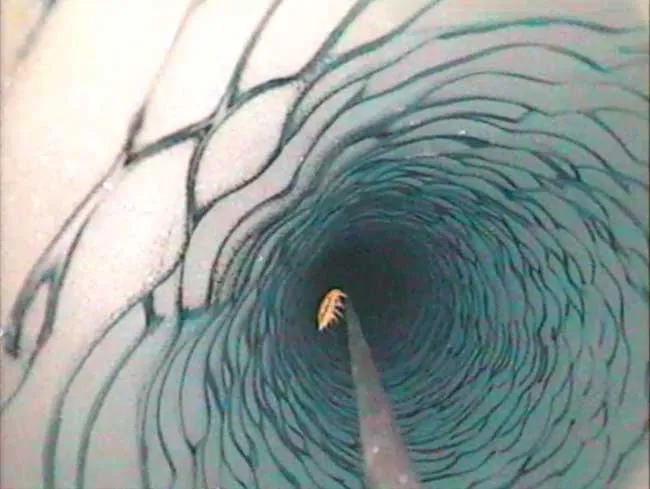
A shrimp-like creature and jellyfish tentacles discovered in the darkness under 600 feet of Antarctic ice, are further evidence of how life can thrive in surprising places.
The pinkish-orange crustacean in question — a 3-inch long creature known as a Lyssianasid amphipod — was discovered last November swimming beneath the Ross Ice Shelf in western Antarctica. NASA scientists used hot water to bore an 8-inch-wide hole in the ice 12 miles from open water, and lowered a camera down as part of research to better understand how the ice is thinning there.
"I didn't expect to see anything inside of the borehole," said researcher Robert Bindschadler, a glaciologist at NASA Goddard Space Flight Center. "Then this critter jumps up, does its little dance."
Moreover, when the scientists recovered the camera, they also discovered what appeared to be translucent jellyfish tentacles up to 8 inches long on the cable.
"Life is incredibly robust, and it keeps popping up, finding its way into all sorts of nooks and crannies," Bindschadler said. "Any individual member of the food web doesn't exist in isolation. I think one can infer quite a bit of life under there."
The newly discovered creatures may have hitched a ride aboard ocean currents reaching under the ice shelf.
"Amphipods live in an enormous variety of habitats on Earth, including extremely deep water around hydrothermal vents," said astrobiologist Richard Hoover at NASA Marshall Space Flight Center. "I would be shocked if they weren't found under the ice."
Get the world’s most fascinating discoveries delivered straight to your inbox.
Normally astrobiologists concentrate their research on microbes when investigating the possibility of alien life. An astonishing recent discovery was of algae in Antarctica that could consume the rare amino acid known as AIB, "which is not usually used by things on Earth as food but is a common component of carbonaceous meteorite," Hoover said. "So AIB is found in Antarctic ice, delivered by meteorites, and these organisms have adapted to use it as a food source during the polar winter."
Still, the possibility of higher life, such as crustaceans, beyond our planet shouldn't be ruled out.
"The more we learn about life in ice, the more we become aware the possibility of life in Europa or Enceladus or comets or the polar caps of Mars is far more possible than previously thought, simply because we didn't know what happens at the polar regions of our own planet," Hoover said.
Bindschadler and his colleagues detailed their findings on Wednesday at an American Geophysical Union meeting in Baltimore.
