













Dragonfly Nymph Attacks Pregnant Mussels
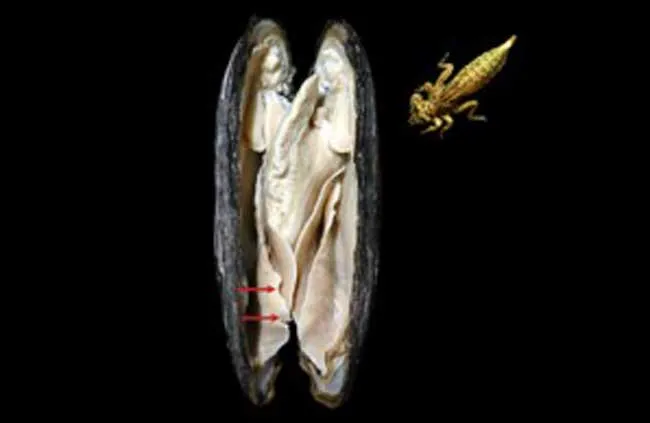
For female freshwater mussels, reproduction is a stressful affair. Now zoologists have discovered an extra burden on pregnant Texas hornshell mussels, Popenaias popeii: an unexpected assailant that eats them away from within.
A mussel mom’s stresses start when her fertilized eggs enter tubes within her gills and develop into glochidia, or larvae. The glochidia reduce water flow, limiting her oxygen and food supplies. Eventually, they enter a parasitic phase, and must relocate to a fish host. So the female often casts her glochidia, embedded in a web of mucus, into the water, hoping that a fish will swim through and pick some up.
Throughout her pregnancy, the mussel is vulnerable to parasitic mites or crustaceans and predatory vertebrates. But during a mussel census in New Mexico, Todd D. Levine, his graduate adviser at the time, David J. Berg of Miami University in Hamilton, Ohio, and a colleague spotted an aggressor unlike any of the others. A nymph of the dragonfly Gomphus militaris was devouring the gills and glochidia of a gravid Texas hornshell. The team went on to find many similarly damaged gravid (but few non-gravid) mussels.
It’s unknown how much the insect, in its dual role as parasite (of female mussels) and predator (of glochidia), affects the Texas hornshells’ survival. But considering that only two populations of the mussels are known, the researchers are hurrying to find out.
The findings were detailed in the American Midland Naturalist.
This article was provided to Live Science by Natural History Magazine.
Get the world’s most fascinating discoveries delivered straight to your inbox.