















Astronauts Photograph Mount Fuji

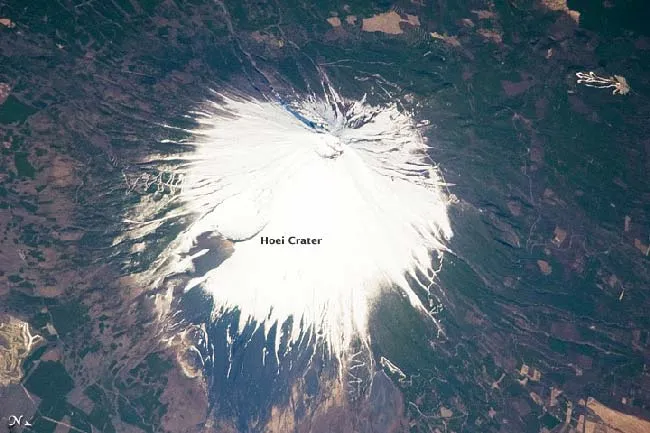
Astronauts got a clear view of Mount Fuji as the International Space Station passed over it in April. The image was released today.
The 12,390-foot-high (3,776-meter) Mount Fuji Volcano, located on the island of Honshu in Japan, is one of the world's classic examples of a stratovolcano, NASA explained in a statement. The volcano's steep, conical profile is the result of numerous layers of lava and debris from explosive eruptions, including ash, cinders, and volcanic bombs, that build up over time.
The steep profile is possible because of the relatively high viscosity (stickiness) of the lava typically associated with stratovolcanoes. The high viscosity leads to thick sequences of lava flows near the eruptive vent that build the cone structure. (Low-viscosity flows spread out over the landscape and build lower-profile shield volcanoes.)
Mount Fuji, or Fuji-san in Japanese, is actually comprised of several overlapping volcanoes that began erupting in the Pleistocene Epoch (1.8 million to approximately 10,000 years ago). The currently active volcano, known as Younger Fuji, began forming approximately 11,000 to 8,000 years ago.
The most recent explosive activity occurred in 1707, creating Hoei Crater on the southeastern flank of the volcano (image center). This eruption deposited ash on Edo (present-day Tokyo), 95 kilometers to the northeast. No further eruptions have occurred at Mount Fuji, but steam was observed at the summit from 1780–1820, and the volcano is considered active.
This looks down at an angle at the snow-covered southeastern flank of the volcano. The northeastern flank is visible in this image.
Last week NASA released a dramatic image from the space station of an erupting volcano that created a shock wave in the atmosphere, clearing clouds as the volcanic plume rose toward space.
Get the world’s most fascinating discoveries delivered straight to your inbox.
- Volcano News, Images & Information
