













Motorbikes Could Run Efficiently on Air

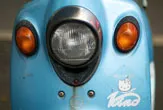
Motorcycles powered by a compressed air engine could cut vehicular emissions in developing countries by more than half, according to Indian researchers.
The engine, which uses a compressed air tank to power a turbine, could be available to consumers within a year, said Bharat Raj Singh, a researcher at the SMS Institute of Technology in Lucknow, India and one of the developers of the engine.
A prototype, modeled in a paper published in May in the Journal of Renewable and Sustainable Energy, is capable of running a motorcycle at speeds of up to 50 mph (80 kph) for 30 minutes. [Read "Cool Vehicles You'll Never Get to Ride."]
Motorcycles are the primary form of transportation in much of India. The bikes are responsible for more than 77 percent of pollution in some areas, Singh said, which could be slashed to almost nothing by swapping gas-guzzling engines for bikes powered by air.
“If we can cut down total pollution in developing countries 50 to 60 percent, that may be a major quantity which can definitely reduce global warming,” Singh said.
Compressed air tanks can be recharged with pumps running off solar or other renewable energy, making them a cheaper, eco-friendly alternative to hybrid electric vehicles, he added.
The engine works by pushing compressed air into a small turbine. The air expands and turns the turbine, powering the motorbike. No fossil fuels are required, and the only waste product is the expanded air.
Get the world’s most fascinating discoveries delivered straight to your inbox.
The major challenge, Singh said, is to develop a compressed air tank that can stand up to long journeys. The current prototype can hold air pressurized to 20 bars, or about 20 times normal air pressure. The researchers are now working to develop a high-pressure tank that can sustain up to 300 bars of pressure. That would boost the running time of the motorbike from 30 minutes to six hours enough to go 155 miles (250 kilometers) without swapping tanks.
If these challenges are overcome, compressed air could power more than motorbikes, Singh said.
The turbine could even be scaled up to power a small car. Similar turbines could be used by individual households to run domestic appliances like vacuums and emergency generators. Families could use wind, solar or electric energy to pressurize their own air tanks, turning homes into miniature power plants, Singh said.
“My next step is in the domestic area,” he said. “In every house, the garden should have an energy tank.”

Stephanie Pappas is a contributing writer for Live Science, covering topics ranging from geoscience to archaeology to the human brain and behavior. She was previously a senior writer for Live Science but is now a freelancer based in Denver, Colorado, and regularly contributes to Scientific American and The Monitor, the monthly magazine of the American Psychological Association. Stephanie received a bachelor's degree in psychology from the University of South Carolina and a graduate certificate in science communication from the University of California, Santa Cruz.