













NASA's New Exoplanet-Hunting Telescope Has Spotted Its Tiniest Alien World Yet

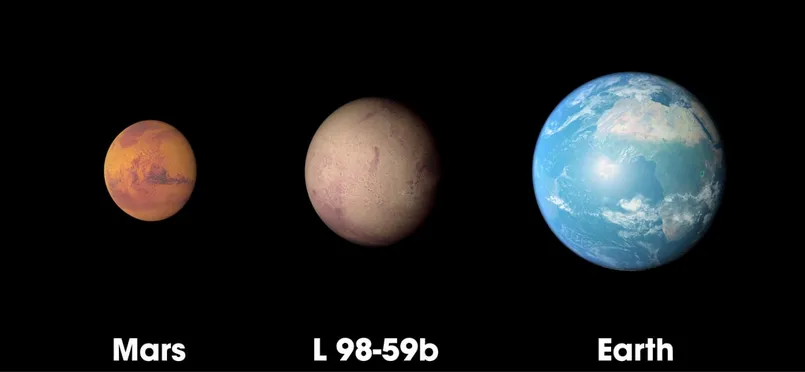
NASA's new exoplanet-hunting telescope has discovered its smallest planet yet: a world somewhere between the sizes of Earth and its smaller sister Mars.
The planet is called L 98-59b because it sits in a nearby star system called L 98-59 that's 35 light-years from our solar system in the southern constellation Volans. L 98-59b is not the smallest exoplanet ever discovered — that record belongs to a tiny rock called Kepler-37b, which is just one-fifth larger than Earth's moon. But ever since NASA's more advanced Transiting Exoplanet Survey Satellite (TESS) space telescope came online, replacing the old Kepler telescope, this is the smallest planet NASA has managed to see.
L 98-59b is one of three planets discovered in the system and reported in a paper published today (June 27) in The Astronomical Journal. The other two are 1.4 and 1.6 times the width of Earth. [9 Most Intriguing Earth-Like Planets]
These planets add to humanity's still-small catalog of exoplanets similar in size to Earth. Most exoplanets that astronomers can detect are much larger than our planet.
To make these detections, TESS didn't observe the planets directly; they're much too small and dim for that, especially sitting next to their bright star. Instead, the telescope spotted their shadows as the orbs passed between their star and the telescope.
The planets orbit a star much smaller than our sun, but they're much closer to it. L 98-59b has the smallest orbit, completing a full circuit of its star every two days and 6 hours, and receiving 22 times the energy Earth absorbs from the sun. That almost certainly renders it uninhabitable (i.e. too hot), just like its detected sister worlds.
However, the researchers wrote that this system is especially interesting because the planets are orbiting such a bright star that it will allow TESS to gather an unusual amount of data from them. Close measurements of their orbits might enable scientists to figure out whether there are other planets in the system tugging on them with gravity — perhaps even planets in that star's habitable zone. That could offer valuable data about how small, rocky planets like ours form. Researchers also hope to learn whether the planets have atmospheres, based on how they add color to the light coming from the star as they pass in front of it.
Get the world’s most fascinating discoveries delivered straight to your inbox.
- 7 Everyday Things That Happen Strangely in Space
- Interstellar Space Travel: 7 Futuristic Spacecraft to Explore the Cosmos
- Photos: The 8 Coldest Places on Earth
Originally published on Live Science.
