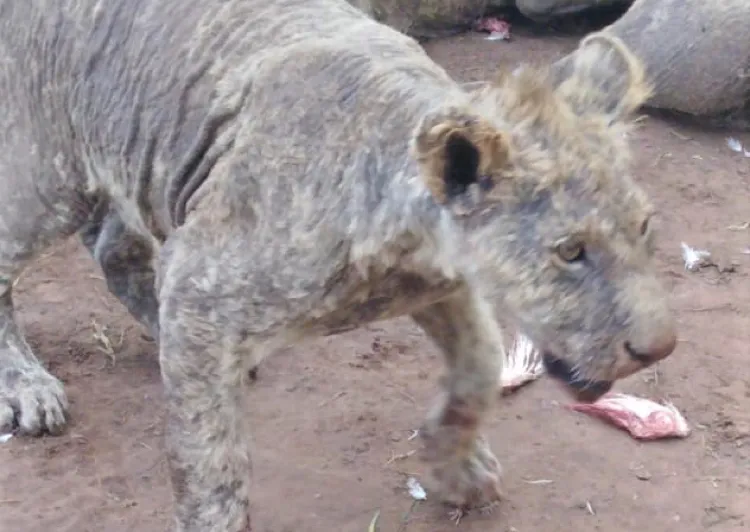
More than 100 lions at a captive breeding facility in South Africa have been found to be neglected, ill and covered with mange.
According to the Humane Society International, the lions were discovered on April 11 by inspectors with the National Council of Societies for the Prevention of Cruelty to Animals. Inspectors told TimesLive, a South African news site, that two lion cubs were suffering from neurological problems and couldn't walk and that 27 lions had lost much of their fur because of the mange, which is caused by parasitic mites.
"Other issues — such as small enclosures and inadequate shelter, no provision of water, overcrowding, and filthy and parasitic conditions — were noted in the camps that contained the lions, caracals, tigers and leopards," senior inspector Douglas Wolhuter told the news site. [In Photos: The Lions of Kenya's Masai Mara]
Many of the lions had lost most of their fur due to mange, which is caused by parasitic mites.
(Image credit: Conservation Action Trust)
Animal cruelty groups that oppose captive breeding of lions were quick to condemn the site, Pienika Farm in South Africa's North West province. Audrey Delsink, the wildlife director of the Humane Society International, said in a statement that lion cubs taken from their mothers are often passed off as orphans at the facilities. The animals are then hand-reared and semitamed so that they can be used as a tourist attraction for visitors who want to feed or pet a lion.
"Once [the animals become] too big and dangerous for these activities, these lions are then killed for their bones, which are exported to Asia for traditional medicines, or [the lions are] sold to be killed by trophy hunters, largely from the United States, in 'canned' hunts in which hand-reared lions are shot in a fenced area from which they cannot escape," Delsink said.
In August 2018, South Africa's parliament reviewed the captive breeding of lions and resolved to reduce the export quota for lion bone as well as conduct a deeper policy review on the oversight of captive breeding, according to a government statement. However, the South Africa Department of Environmental Affairs has proposed introducing additional regulations, rather than ending captive breeding, according to the nonprofit Conservation Action Trust.
The owner of Pienika Farm, Jan Steinman, faces criminal charges for animal cruelty, according to the U.K. newspaper The Times. Steinman is a councilwoman of the South African Predator Association, a body that sets the standards for animal welfare at lion-breeding facilities.
Sign up for the Live Science daily newsletter now
Get the world’s most fascinating discoveries delivered straight to your inbox.
Stephanie Pappas is a contributing writer for Live Science, covering topics ranging from geoscience to archaeology to the human brain and behavior. She was previously a senior writer for Live Science but is now a freelancer based in Denver, Colorado, and regularly contributes to Scientific American and The Monitor, the monthly magazine of the American Psychological Association. Stephanie received a bachelor's degree in psychology from the University of South Carolina and a graduate certificate in science communication from the University of California, Santa Cruz.