













1,500-Year-Old Maya Altar Reveals Amazing Secrets of the 'Snake Kings'

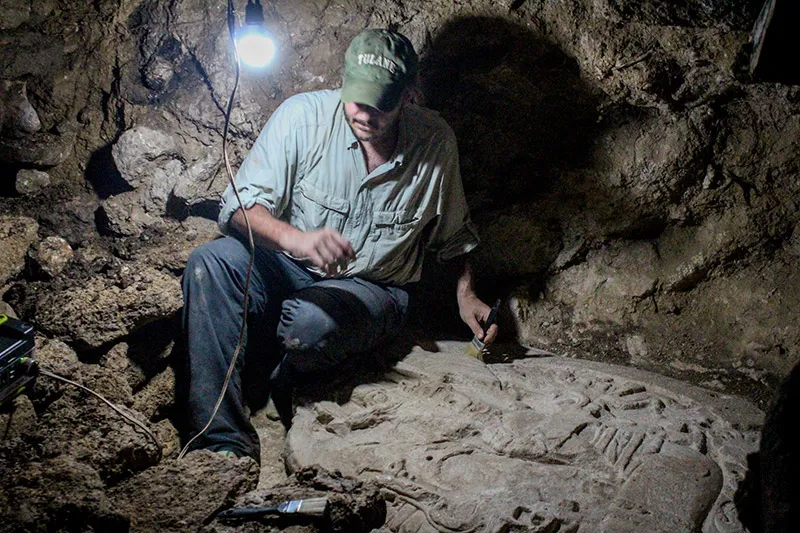
Archaeologists have discovered a nearly 1,500-year-old carved stone altar in the ancient Maya city of La Corona, deep in the jungles of northern Guatemala.
The finding, announced Sept. 12 at the National Museum of Archaeology and Ethnology in Guatemala City, is the oldest monument on record at the La Corona site from the Classic Maya period, which lasted from A.D. 250 to 900, the archaeologists said.
An analysis of the carvings on the altar revealed how the powerful Kaanul dynasty started its 200-year rule over much of the Maya lowlands, the archaeologists said. [In Photos: Ancient Maya Carvings Exposed in Guatemala]
"The discovery of this altar allows us to identify an entirely new king of La Corona who apparently had close political ties with the capital of the Kaanul kingdom, Dzibanche, and with the nearby city of El Peru-Waka," Marcello Canuto, director of the Middle American Research Institute at Tulane University and co-director of the La Corona Regional Archaeological Project (PRALC), said in a statement.
The altar, carved out of a large slab of limestone, depicts the previously unknown king — Chak Took Ich'aak — carrying a double-headed serpent. The site's patron gods are emerging out of the conjoined snakes, Canuto said. This animal isn't a coincidence, as the rulers of the Kaanul dynasty were also known as the "snake kings," according to National Geographic.
Next to this carving is a column of hieroglyphs that show the end of the half-katun period in the long count Maya calendar, where a katun is a unit of time, giving a date that corresponds to May 12, 544.
"For several centuries during the Classic period, the Kaanul kings dominated much of the Maya lowlands," Tomas Barrientos, co-director of the project and director of the Center for Archaeological and Anthropological Research at the University of the Valley of Guatemala, said in the statement. "This altar contains information about their early strategies of expansion, demonstrating that La Coronaplayed an important role in the process from the beginning."
Get the world’s most fascinating discoveries delivered straight to your inbox.
Canuto and Barrientos have studied La Corona since 2008, directing excavations, translating hieroglyphs and surveying the area with lidar (which stands for "light detection and ranging"), a technology that uses billions of light beams to map the topography of terrain. They've also taken part in chemical and material analyses.
With PRALC, their team will investigate the altar to see if it contains additional secrets about how the Kaanul kingdom came to exercise so much power over the Maya lowlands.
Original article on Live Science.

Laura is the managing editor at Live Science. She also runs the archaeology section and the Life's Little Mysteries series. Her work has appeared in The New York Times, Scholastic, Popular Science and Spectrum, a site on autism research. She has won multiple awards from the Society of Professional Journalists and the Washington Newspaper Publishers Association for her reporting at a weekly newspaper near Seattle. Laura holds a bachelor's degree in English literature and psychology from Washington University in St. Louis and a master's degree in science writing from NYU.