














World First: Chinese Physicists Made a Cold Atomic Clock Work in Space

Telling time precisely is important; it gets you up in the morning and coordinates everything from air travel to the GPS system. And if you do it well enough, you can even use it to navigate outer space.
But telling time is also a major technical challenge. Every clock in the world is inaccurate to some degree. Whatever technology your wristwatch uses to mark the future ticking away into the past, those ticks will be imperfectly measured. Every once in a while, a fraction of a second gets lost. Even atomic clocks — which measure time by observing the ultraprecise oscillations of individual atoms and make up the world's official timekeepers — are imperfect, which is why researchers are always striving to build one that's a bit more accurate than any that have been built before. And now, for the first time, a team of Chinese researchers has figured out how to make one of the most precise atomic-clock technologies currently available work in space.
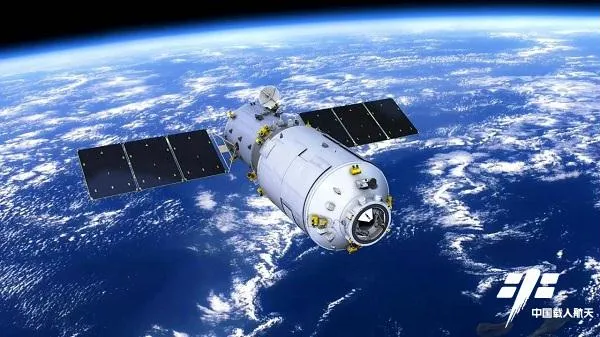
In a paper published today (July 24) in the journal Nature Communications, a team of researchers from the Shanghai Institute of Optics and Fine Mechanics at the Chinese Academy of Sciences officially announced that they had successfully operated a cold atomic clock for more than 15 months in orbit aboard the now-defunct Chinese space station Tiangong-2. (The accomplishment was originally reported in Science magazine in September 2017, when a version of the paper went live in the preprint journal arXiv before it went through peer review and the formal publication process.) [Wacky Physics: The Coolest Little Particles in Nature]
Cold atomic clocks, which work by laser-cooling atoms to near absolute zero before measuring their oscillations, can be more precise, because at very low temperatures, these "ticks" are more consistent. But actually getting atoms to those temperatures is very difficult on Earth, let alone in the confines of a spacecraft.
Cold atomic clocks measure the vibrations of atoms while they're in free fall so that they aren't interacting with anything else. On Earth, that requires constantly nudging an atom up so that it can be measured while it's falling through the detector.
Researchers have managed to make atoms ultracold in free fall before, the team wrote in the paper. But that meant more or less tossing the experiment into the air and letting it fall.
"These methods provide a microgravity environment ranging from several seconds (drop tower, parabolic flight) to several minutes (sounding rocket)," they wrote in the study.
Get the world’s most fascinating discoveries delivered straight to your inbox.
It's difficult to make such a device function in orbit, the researchers wrote, because it has to be much smaller than its counterparts on Earth, pass the safety tests necessary to launch into space, work in microgravity, shield itself against cosmic radiation — and do all that without any quantum physicists on hand to make adjustments if anything were to go wrong.
But space-bound cold atomic clocks do have some advantages, the researchers wrote. Most important, they can study the atomic oscillations over much longer periods. In microgravity, the atom can stay in place longer, allowing for a longer period of measurement.
As Science reported in 2017, researchers with the European Space Agency (ESA) said Tiangong-2's cold atomic clock was not as precise as it could have been. But ESA's clock — which, in theory, would be more precise — has faced delays and has never actually gone up into space.
Originally published on Live Science.
