













Why Earth's Magnetic Field Might Not Flip After All

A gradual weakening in Earth's geomagnetic field has raised concerns that the field could flip, reversing magnetic north and south. But now, new research suggests the field has been in a similar state before — without making a move.
In a study published in the journal Proceedings of the National Academy of Sciences today (April 30), researchers compared the current magnetic field, which is created by the churning of Earth's core, with the magnetic field of eons past. They found that today's patterns don't resemble the two most extreme disruptions in the past 50,000 years, when the magnetic field nearly reversed. [7 Ways the Earth Changes in the Blink of an Eye]
Instead, the modern field appears similar to the field during two other periods — one 49,000 ago, and one 46,000 years ago — when the field wobbled but didn't flip-flop.
Even a wobble, though, could have ramifications, the authors wrote. If the field continues to weaken, it could affect things like electronics aboard low-Earth-orbit satellites, even without a total reversal of magnetic north and south.
Protective feature
Earth's geomagnetic field shields the planet's surface from damaging charged particles in space, so it's important for both life on Earth and the electric grid. "Solar storms" that barrage Earth with higher-than-usual levels of charged particles can cause problems with satellite communications and even the electrical grid, as happened in 2003, when "Halloween storms" forced the rerouting of aircraft and took out power in parts of Sweden for an hour.
Currently, magnetic north is very close to the North Pole, while magnetic south is near the South Pole. That's been the case for about 780,000 years — the last time the geomagnetic field underwent a complete reversal, with magnetic north and south swapping places. But the field has been weakening by about 5 percent per century since direct observations started in 1840, and indirect observations hint that this weakening might have been going on for at least 2,000 years, Maxwell Brown, who studies paleomagnetism at the University of Iceland, and his colleagues wrote in their new paper. A particularly weak area called the South Atlantic Anomaly, which stretches from South Africa to Chile, has been pinpointed as a potential ground zero for a global polarity reversal.
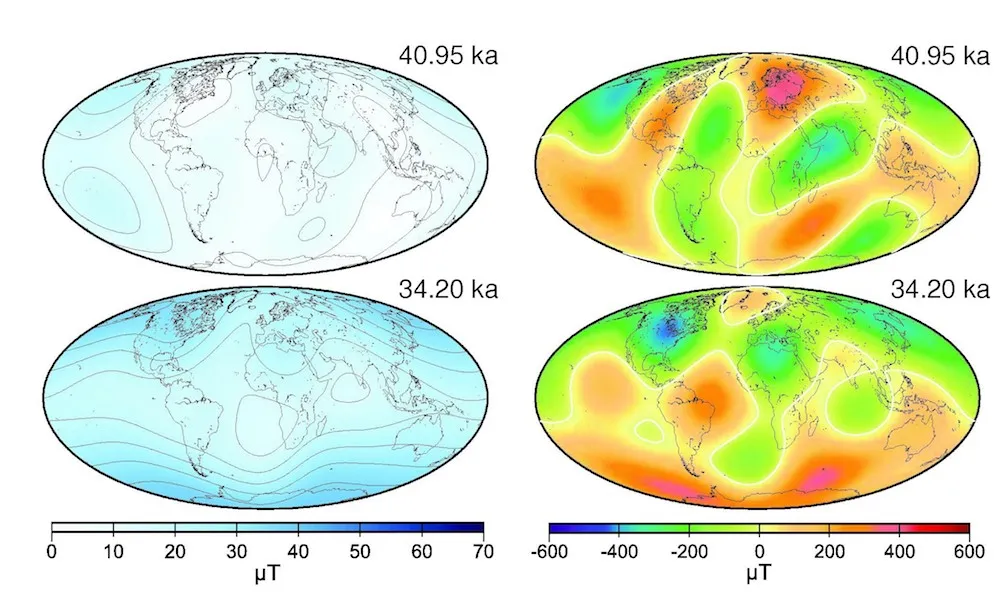
Brown and his colleagues wanted to compare today's conditions with the magnetic field of years past. They focused on two "excursions," which are major disruptions of the geomagnetic field that don't necessarily involve a global reversal of magnetic north and south. One, the Laschamp excursion, occurred about 41,000 years ago. During that excursion, the magnetic field was a complex muddle without a clear magnetic north and south. The other, the Mono Lake excursion, happened about 34,000 years ago and was marked by a very weak magnetic north and south.
Get the world’s most fascinating discoveries delivered straight to your inbox.
Natural variation
The researchers modeled these geomagnetic hiccups and found that neither looked much like the field's conditions today. During the Laschamp excursion, magnetic north and south weakened with increasing rapidity, and two large anomalies grew over Central America and Southeast Asia almost simultaneously. Over thousands of years, patches where the direction of magnetism was reversed popped up, and the intensity of the magnetic field dropped very low.
During the Mono Lake excursion, magnetic north and south weakened but for a shorter period of time, and lots of little patches of reverse magnetism appeared across the globe. There were also lots of patches of altered intensity in the field's strength, which appeared erratically and vanished again. Over a couple thousand years, the field stopped wavering and stabilized again with a strong north and south.
Today's field isn't as weak as the field was during the Laschamp or Mono Lake excursions, and it has just the one intensity anomaly, the South Atlantic Anomaly. So, Brown and his co-authors argue that this isn't enough to seed a full global flip-flop. Rather, they wrote, a major excursion or magnetic field reversal probably requires a lot of little nucleus points around the globe. Backing up their argument, they found two times — 49,000 years ago and 46,000 years ago — when the geomagnetic field looked a lot like today's. In both cases, the field recovered without any extreme events resulting.
If the researchers are right and the magnetic field doesn't reverse, there could still be headaches in store for humans. Already, the South Atlantic Anomaly has occasionally caused electrical failures on satellites, Brown and his colleagues wrote.
"[W]ith a continued decrease in field intensity," they continued, "issues such as this will become more widespread."
Original article on Live Science.

Stephanie Pappas is a contributing writer for Live Science, covering topics ranging from geoscience to archaeology to the human brain and behavior. She was previously a senior writer for Live Science but is now a freelancer based in Denver, Colorado, and regularly contributes to Scientific American and The Monitor, the monthly magazine of the American Psychological Association. Stephanie received a bachelor's degree in psychology from the University of South Carolina and a graduate certificate in science communication from the University of California, Santa Cruz.