Here, the orbit of Tiangong-1 as of March 22, 2018. The highest point in the orbit, called its apogee, is 145 miles (233 km) above Earth, and its lowest point is about 130 miles (212 km). The International Space Station is in a 250-mile (400 km) circular orbit.
China's defunct Tiangong-1 space station is careening through low-Earth orbit right now, and is expected to reenter Earth's atmosphere sometime between March 30 and April 2. Most of the 9-ton (8,500 kilograms) space station will probably burn to bits in the atmosphere — but a few thousand chunks of hot, mangled debris are still likely to survive the trip and land on our planet's surface.
Your odds of being conked on the head by any of this debris are low — about one in 292 trillion, or roughly a million times less likely than hitting the Powerball jackpot. Right now, the potential impact site of the space station covers about one-third of the planet, and a huge majority of that zone is water. However, if by some truly cosmic coincidence you do find a piece of Tiangong-1 in your neighborhood — or if some debris washes up on a shore near you — here's some advice on your best course of action: Don't touch it.
"There are two reasons why you should not approach and touch a piece of space debris," Robert Z. Pearlman, a space historian and editor of collectSPACE.com, told Live Science. "The first is it is a health risk."
Presumably, Pearlman said, the space station is carrying all manner of hazardous materials not safe for human contact, including fuel tanks with noxious fuel inside. "Also, because this vehicle is going to be ripped apart by the process of reentry, whatever does survive to the ground could have very sharp edges," Pearlman added. "It’s not something you want to have your kids run out to touch."
Finders keepers?
The second reason not to rush out and bag a chunk of Tiangong-1 is the galaxy of legal trouble it could land you in.
"According to the Outer Space Treaty of 1967, a country’s spacecraft is their legal property until they say that it’s not their legal property,” Pearlman said. "No matter where it lands — whether it lands in the ocean and sinks to the bottom of the sea, or whether it lands on their own land or some other country’s land — it belongs to that country of origin."
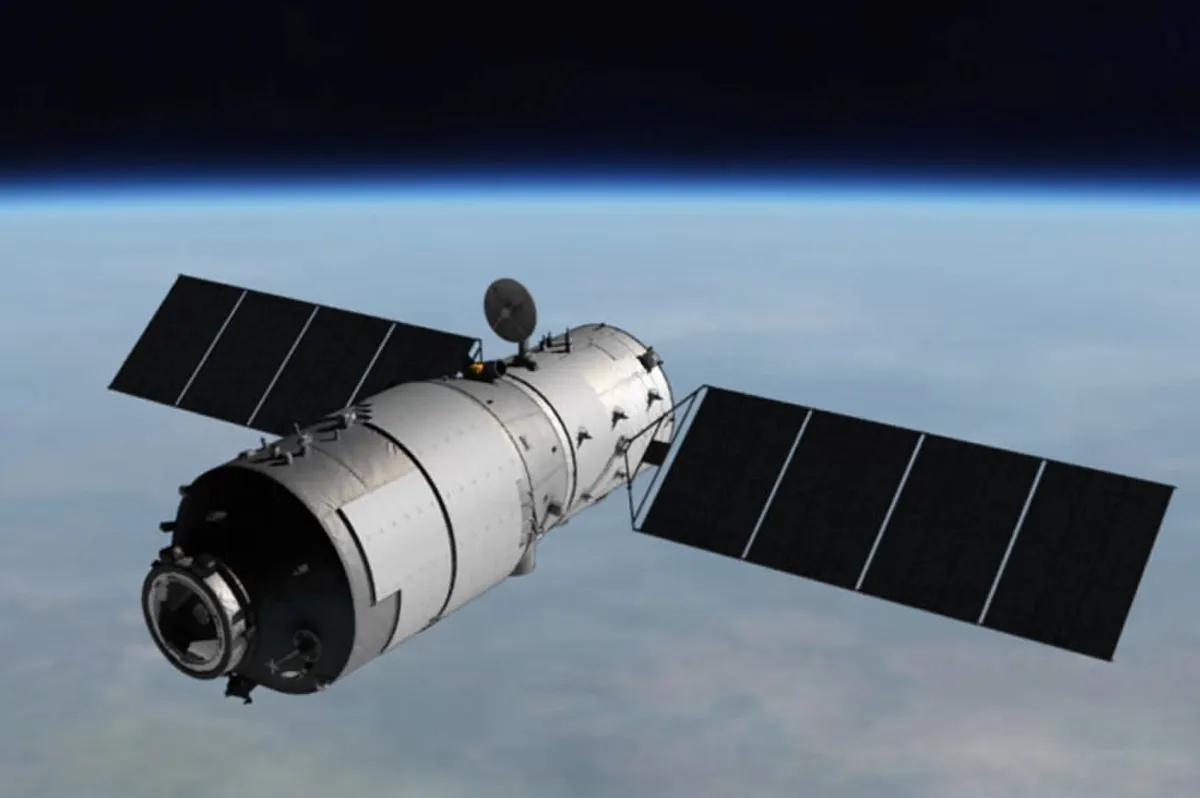
An artist's Illustration of China's Tiangong-1 space lab, which is expected to fall back to Earth between March 30 and April 2, 2018.
(Image credit: CMSA)
Part of this legal framework is for your protection, Pearlman said; it makes China legally liable for any damage to person or property that their out-of-control space station may cause. (Again, such damage is unlikely to happen.)
Sign up for the Live Science daily newsletter now
Get the world’s most fascinating discoveries delivered straight to your inbox.
However, it also means that pocketing a piece of Tiangong-1 is tantamount to theft of government property. Believe it or not, people have gone to jail for this.
"Following the Challenger explosion [in 1986], there was a gentleman in the Coast Guard who kept a piece of debris for 25 years," Pearlman said. "He was the cook onboard the ship working on the investigation. While his fellow sailors were out helping with recovering pieces, he decided to use a bucket to scoop up a tile floating in the water and keep it for himself. He put it away for 25 years and then listed it on eBay as 'the ultimate Christmas gift.'"
When NASA found out, the man was arrested. He was found guilty of theft of government property, and sentenced to two years probation. He got off easy; he could have received a $10,000 fine, 10 years in prison, or a combination of both.
Space debris can become a legally legitimate souvenir, however, once the government of origin officially concludes its investigation. Until then, it's probably best to treat any pieces of Tiangong-1 like what they are: hot, mangled wreckage.
So, what should you do if you find a piece of what you think is space debris? "The best thing to do is to contact your local authorities," Pearlman said. "They will contact the federal authorities and arrange for the proper collection and appropriate return to the Chinese government."
"All that being said," Pearlman jokes, "if a piece of debris lands in my backyard — it's mine, all mine!"
Brandon is the space / physics editor at Live Science. With more than 20 years of editorial experience, his writing has appeared in The Washington Post, Reader's Digest, CBS.com, the Richard Dawkins Foundation website and other outlets. He holds a bachelor's degree in creative writing from the University of Arizona, with minors in journalism and media arts. His interests include black holes, asteroids and comets, and the search for extraterrestrial life.