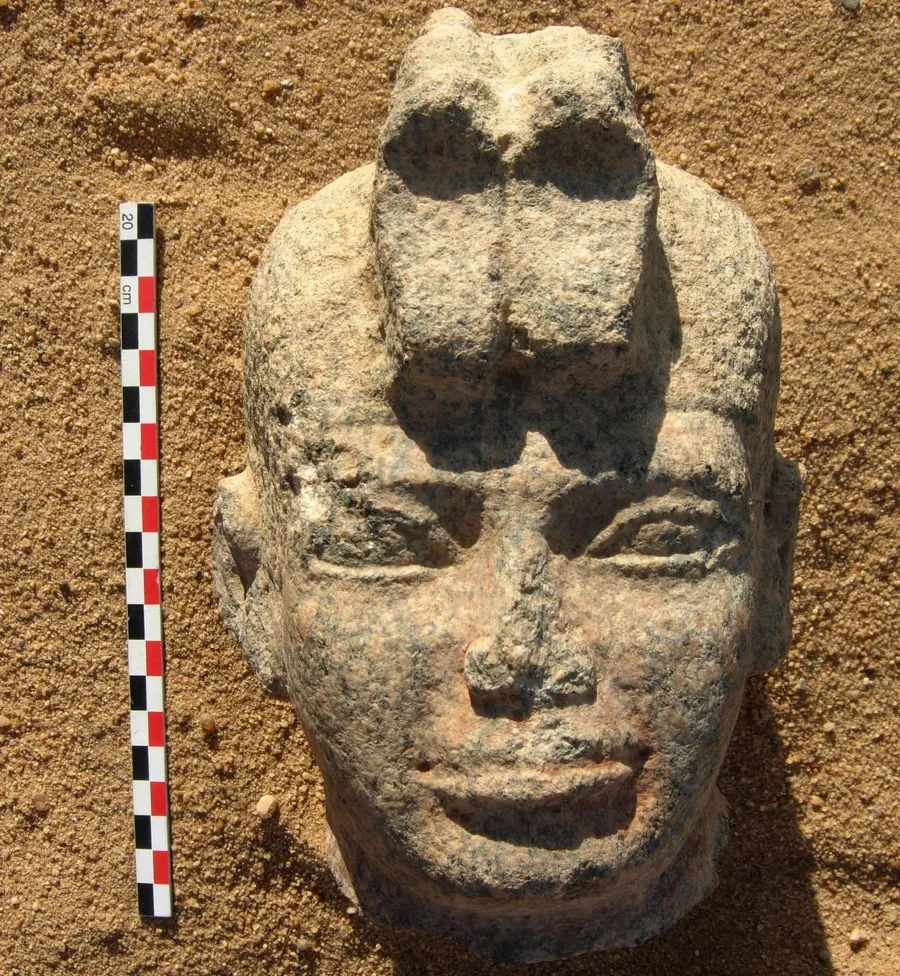
Remains of a 2,600-year-old statue with an inscription written in Egyptian hieroglyphics has been discovered in a temple at Dangeil, an archaeological site along the Nile River in Sudan.
Found in an ancient temple dedicated to the Egyptian god Amun, the statue depicts Aspelta, who was the ruler of the Kush kingdom between 593 B.C. and 568 B.C. Some of Aspelta's predecessors had ruled Egypt, located to the north of Kush. Though Aspelta didn't control Egypt, the inscription says (in translation) that he was "King of Upper and Lower Egypt" and was "Beloved of Re'-Harakhty" (a form of the Egyptian sun god "Re") and that Aspelta was "given all life, stability and dominion forever."
"Being 'Beloved of a god' confers legitimacy on a ruler," wrote archaeologists Julie Anderson, Rihab Khidir el-Rasheed and Mahmoud Suliman Bashir, who co-direct excavations at Dangeil, in an article published recently in the journal Sudan and Nubia. The "Kushite kings were closely tied to Re," they noted. [See Photos of the Newfound Statue with Hieroglyphics]
While Kush lost control of Egypt during the reign of a king named Tanwetamani (reign circa 664–653 B.C.), his successors, including Aspelta, still called themselves "King of Upper and Lower Egypt," Anderson, an assistant keeper at the British Museum, told Live Science. The title "may be viewed as general assertions of authority using the traditional titles, and not a claim to Egypt," Anderson said.
Putting Aspelta back together
In 2008, archaeologists found parts of the Aspelta statue, including the head, along with statues depicting two other Kushite kings — Taharqa (reign ca. 690–664 B.C.) and Senkamanisken (reign ca. 643-623 B.C.).
The statue parts were found in a temple (main gate shown here) dedicated to the god Amun.
However, those Aspelta statue parts held little of the hieroglyphic inscription, preventing archaeologists from firmly identifying the statue as depicting Aspelta. It wasn't until new pieces of the statue that had the hieroglyphic inscription were discovered during fieldwork in 2016 and 2017 that archaeologists could identify the statue and begin the process of putting it back together.
Archaeologists won't know the statue's exact dimensions until more reconstruction work is done, but, based on what they have so far, they estimate that the statue of Aspelta is "approximately half life-size."
Sign up for the Live Science daily newsletter now
Get the world’s most fascinating discoveries delivered straight to your inbox.
Amun temple
The Amun temple, where the statues of Aspelta, Taharqa and Senkamanisken were discovered, dates back at least 2,000 years. The statues were likely constructed during the lifetimes of their respective kings and were displayed long after those kings died, Anderson said.
"Statues might be displayed in temples, particularly the forecourts of temples, after the reigns of the kings, as they may have served as intermediaries between the people and the gods in popular religion," Anderson told Live Science.
People used the Amun Temple until the late third to early fourth century, when the temple ceased to function. The kingdom of Kush also collapsed during the fourth century.
Later burials
Between the late 11th and early 13th centuries, long after the Amun temple had fallen into ruin, people were digging graves in the ruined temple, archaeologists found.
Eight tombs excavated during the 2016 and 2017 field seasons contained the remains of several adult women and at least one juvenile. Inside those tombs, the researchers found a trove of jewelry, including necklaces, beaded belts, rings, bracelets and anklets. Altogether, the eight tombs held about 18,500 beads and more than 70 copper bracelets, she noted, adding that it dates back to a time when Christianity was widely practiced in the area.
The vast amount of jewelry "suggest this is an elite group" Anderson said, but archaeologists aren't sure about who these people were.
The excavations at Dangeil are a mission of the National Corporation for Antiquities and Museums (NCAM), Sudan. The mission is sponsored by the Qatar-Sudan Archaeological Project. Mahmoud Suliman Bashir and Rihab Khidir el-Rasheed are both archaeologists with NCAM.
Owen Jarus is a regular contributor to Live Science who writes about archaeology and humans' past. He has also written for The Independent (UK), The Canadian Press (CP) and The Associated Press (AP), among others. Owen has a bachelor of arts degree from the University of Toronto and a journalism degree from Ryerson University.