














A Man's Eye Floater Was Actually a Tapeworm — Plus Thousands of Its Eggs

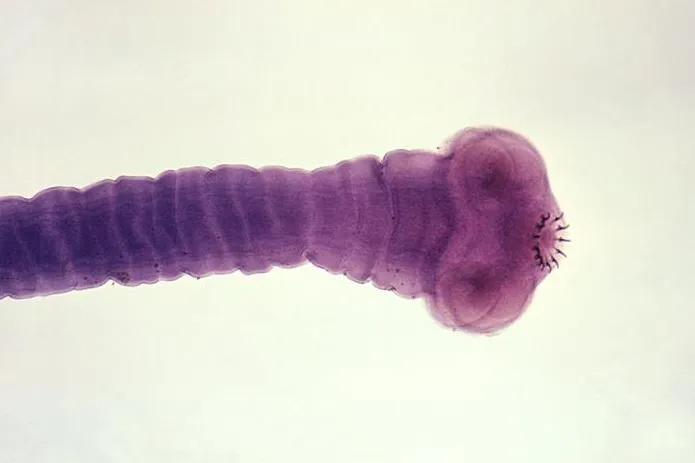
A tapeworm in your gut sounds horrifying enough, but imagine having a tapeworm in your eye.
That's what happened to a man in Florida who initially thought he saw something moving across his vision, only to discover he had tapeworm living in his eye, according to news reports.
The man, Sam Cordero, recently went to the doctor after experiencing vision problems. "I see a little black dot and it's only on the left eye. I see something moving from left to right," Cordero told the news station WFTS in Tampa.
Cordero turned out to have an infection with Taenia solium, a pork tapeworm. The parasite traveled from his intestines through his bloodstream and into his eye. By the time he saw a doctor, the worm was living in the fluid-filled area behind the eye's lens, called the vitreous chamber, WFTS reported.
T. solium is a parasitic infection that people can get by eating raw or undercooked pork, according to the Centers for Disease Control and Prevention. Cordero said he believes he ate undercooked pork around Christmastime. ['Eye' Can't Look: 9 Eyeball Injuries That Will Make You Squirm]
Most people infected with this tapeworm don't experience any symptoms, the CDC says, although some people with intestinal infections may experience abdominal pain, loss of appetite and weight loss.
Eye infections with pork tapeworms are rare: Only about 20 such cases have been reported worldwide, according to WFTS. Despite its rarity, Cordero's ophthalmologist, Dr. Don Perez, has now treated two patients with tapeworm eye infections. (Perez first treated a patient with the infection in 2012.)
Get the world’s most fascinating discoveries delivered straight to your inbox.
"I've been hit with lightning because you seldom see this," Perez told WFTS.
Pork tapeworms in the eye can cause blindness. The worm's eggs can also infect the brain, where they grow into cysts. (A person does not need to have an eye infection with the parasite for it to infect the brain; it can infect the brain from elsewhere in the body.)
Cordero had an eye procedure to have the tapeworm removed. During the procedure, Perez suctioned out a 3-millimeter (0.1 inches) tapeworm, along with tens of thousands of eggs, WFTS said.
Cordero is now parasite-free and has no vision problems. He says he will make a change to his lifestyle after his medical ordeal: He will no longer eat pork.
Original article on Live Science.

Rachael is a Live Science contributor, and was a former channel editor and senior writer for Live Science between 2010 and 2022. She has a master's degree in journalism from New York University's Science, Health and Environmental Reporting Program. She also holds a B.S. in molecular biology and an M.S. in biology from the University of California, San Diego. Her work has appeared in Scienceline, The Washington Post and Scientific American.