














A Boy Scrapes His Elbow. One Week Later, Docs Find a Sea Snail in the Wound.
A scraped elbow may not seem like an unusual injury, but for one 11-year-old boy in California, his health took an odd turn after he fell and hurt his left elbow while exploring a tide pool.
The boy's parents cleaned his wound after the incident, but noticed during the following week that the "blister" on his left elbow wasn't healing, but instead was gradually getting bigger, according to a report of the boy's case, which was published Feb. 7 in the journal BMJ Case Reports.
Concerned that their son might have a skin infection, his parents took him to see his pediatrician. After examining the boy's red and swollen elbow, his doctor diagnosed him with a skin abscess, or pus-filled infection, according to the case report. [27 Oddest Medical Cases]
The standard treatment for an abscess is to drain the wound, and the doctor did just that. But as the doctor cut into the boy's elbow, he noticed a small, dark-colored object inside of it.
The object turned out to be a tiny sea snail, snuggled firmly in its shell, according to the report. Even more surprisingly — though the doctor and patient didn't know it at the time — the snail was still alive.
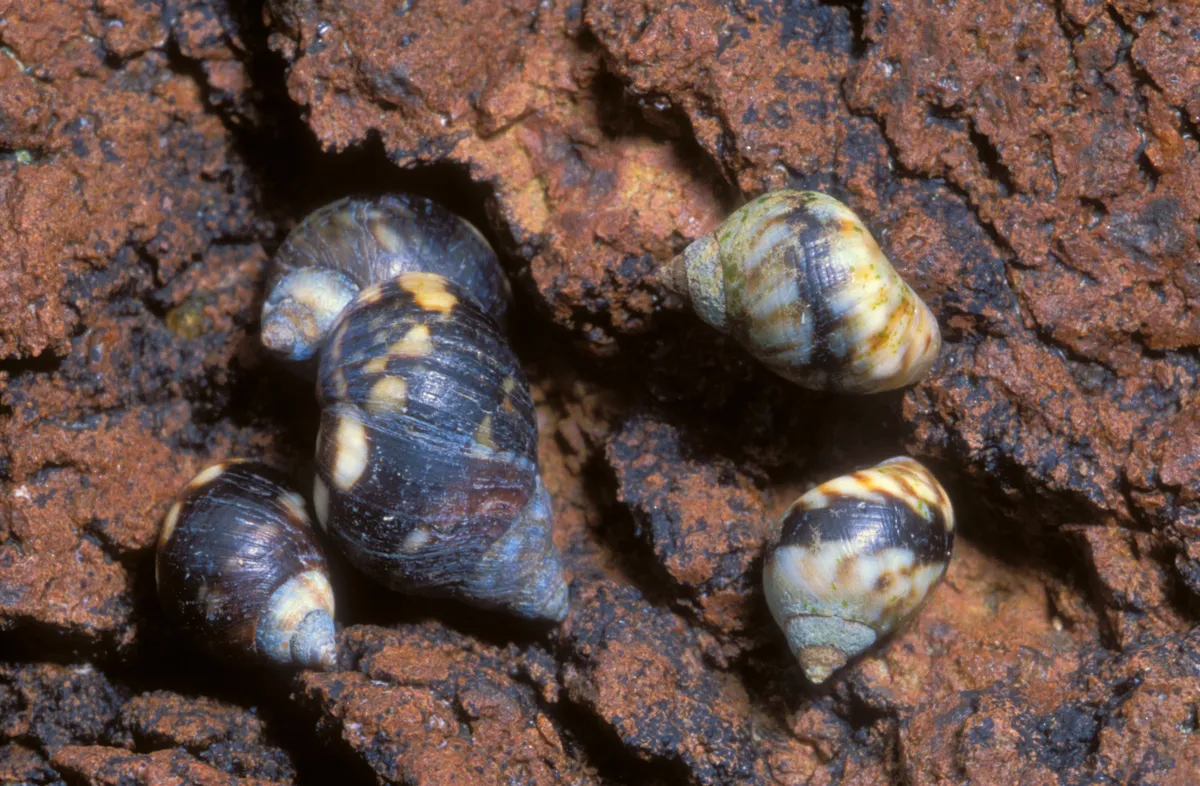
Checkered periwinkle
So, what's a pediatrician to do when he finds a marine animal inside a skin abscess?
Lead author Dr. Albert Khait, an assistant professor of pediatrics at Loma Linda University in Loma Linda, California, who treated the boy, said he reached out to a mollusk expert at the Natural History Museum of Los Angeles County, who identified the snail as a checkered periwinkle marine snail (Littorina scutulata).
Get the world’s most fascinating discoveries delivered straight to your inbox.
The egg of the checkered periwinkle, referred to as a micro snail, likely got into the boy's skin when he slipped and scraped his elbow on the wet rock while he was fetching a sea cucumber, which is another type of marine animal, Khait told Live Science. "This is a young snail, though it is bigger than something that can enter the skin unnoticed," he added.
A checkered periwinkle can have a dark, smooth shell, with a white checkerboard pattern, according to the Slater Museum of Natural History in Washington state. The small, pointy-shelled snails feed on algae found on rocks, and, unlike most marine organisms, spend much of their time out of the water. [Dangers in the Deep: 10 Scariest Sea Creatures]
"A unique visitor inside the human body"
One of the unique features of the checkered periwinkle is that it can seal its shell shut, which keeps water and moisture inside, and prevents the snail from drying out and suffocating, according to the case report.
"These characteristics made the checkered periwinkle a unique visitor inside the human body," the case report authors wrote.
What's more, sea snails can thrive in the ocean under extreme temperatures and pressure, Khait said. "This is probably why it was able to live in the abscess as well," he added.
Given the boy's interest in tide pools and marine life, he thought it was cool that his doctor found a sea snail in his elbow. He asked to keep the critter as a reminder of his adventure.
So, after Khait bandaged up the wound and prescribed a course of antibiotics, he placed the sea snail in a specimen jar and the boy took it home to show his friends.
A week later, when Khait called the family to see how the boy was doing, he found out that the wound had fully healed. He was also fascinated to learn that the boy said he saw the snail move on his first day home — meaning it was alive — but there was no movement after that.
After removing the snail, it was hard to tell just by looking at it whether it was still living, but since the snail had grown in size and the family reported it moving, this was the obvious conclusion, Khait said.
Originally published on Live Science.
Cari Nierenberg has been writing about health and wellness topics for online news outlets and print publications for more than two decades. Her work has been published by Live Science, The Washington Post, WebMD, Scientific American, among others. She has a Bachelor of Science degree in nutrition from Cornell University and a Master of Science degree in Nutrition and Communication from Boston University.