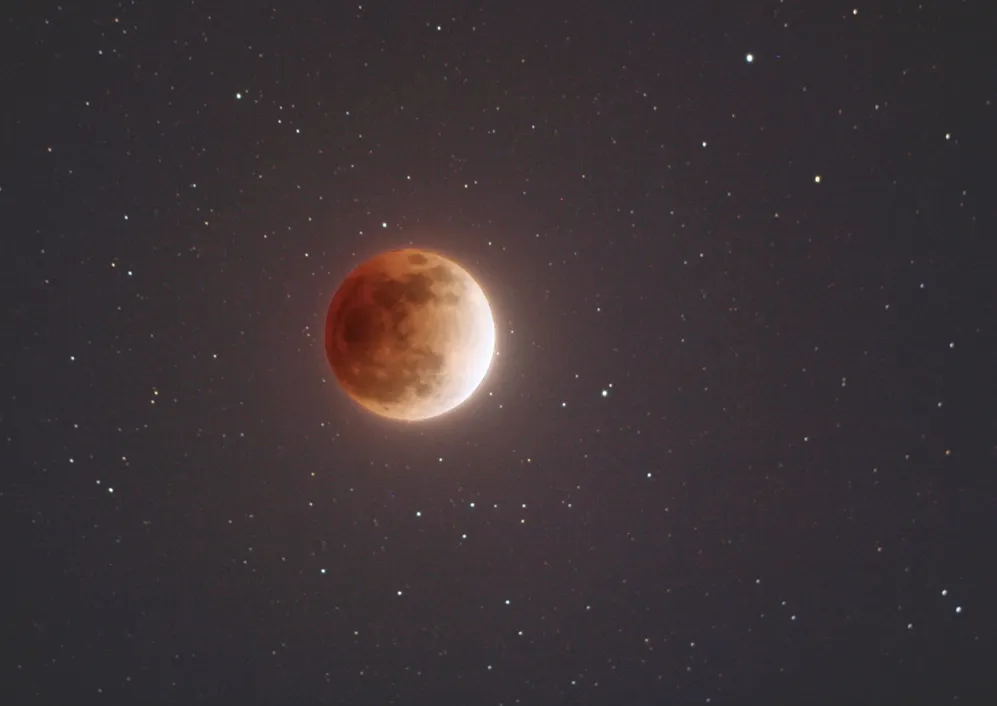
People who peer up at the night sky this Wednesday (Jan. 31) may see something like this illustration, which shows a blood moon during a total lunar eclipse.
Imagine going to a drive-thru and ordering the following: a blue moon, a supermoon, a blood moon and a total lunar eclipse. Although such a request is impossible (if only!), all four events are actually happening tomorrow (Jan. 31).
But what, exactly, are these four celestial treats? And how rare is it that skywatchers can view all of them on the same night?
Even separately, these events are rare. For instance, a blue moon happens when two full moons occur within the same calendar month. Normally, Earth has 12 full moons per year, which equates to one per month. But because the lunar month — the time between two new moons — averages 29.530589 days, which is shorter than most months (with the exception of February), some years have 13 full moons, Live Science previously reported.
Blue moons happen once every 2.7 years, which explains why the last one happened on July 31, 2015. But despite their name, blue moons don't actually appear blue. A bluish tint is only possible when smoke or ash from a large fire or volcanic eruption gets into the atmosphere. These fine particles can scatter blue light and make the moon appear blue.
Supermoons, however, are more common than blue moons. A supermoon happens when a full moon is at or near perigee, the point in the moon's monthly orbit when it's closest to Earth. Because they're marginally closer to Earth, supermoons can appear up to 14 percent larger and up to 30 percent brighter than regular full moons, Live Science previously reported.
The most recent supermoon happened this past New Year's Day, on Jan. 1, 2018. Because the upcoming full moon will be January's second full moon, it has earned the title of "blue moon."
Sign up for the Live Science daily newsletter now
Get the world’s most fascinating discoveries delivered straight to your inbox.
Finally, the last two events — the total lunar eclipse and the blood moon — are linked. A total lunar eclipse can happen only when the sun, Earth and full moon are perfectly lined up, in that order. With this alignment, the full moon is completely covered in Earth's shadow.
A composite image showing the total lunar eclipse that happened during a supermoon on Sept. 27, 2015, as seen from Denver. Before 2015, the last supermoon-and-total-lunar-eclipse combo happened in 1982.
(Image credit: NASA/Bill Ingalls)
During a total lunar eclipse, the moon may appear "blood red," or at least ruddy brown. This unusual hue happens because when the moon is covered by Earth's shadow, some of the light from Earth's sunrises and sunsets falls on the moon and makes it appear red, at least from Earth, according to Space.com, a Live Science sister site.
The last total lunar eclipse happened during Sept. 27 and 28, 2015. To watch the upcoming total lunar eclipse, tune into Space.com.
Skywatchers in North America will be able to see the total lunar eclipse before sunrise on Jan. 31. People in the Middle East, Asia, eastern Russia, Australia and New Zealand will be able to view it during moonrise on the evening of Jan. 31, according to NASA.
However, the supermoon will be visible worldwide, as will the blue moon, so long as there isn't too much cloud cover.
Laura is the managing editor at Live Science. She also runs the archaeology section and the Life's Little Mysteries series. Her work has appeared in The New York Times, Scholastic, Popular Science and Spectrum, a site on autism research. She has won multiple awards from the Society of Professional Journalists and the Washington Newspaper Publishers Association for her reporting at a weekly newspaper near Seattle. Laura holds a bachelor's degree in English literature and psychology from Washington University in St. Louis and a master's degree in science writing from NYU.