













Sea Stars Make a Comeback After Mysterious 'Goo' Disease Killed Millions

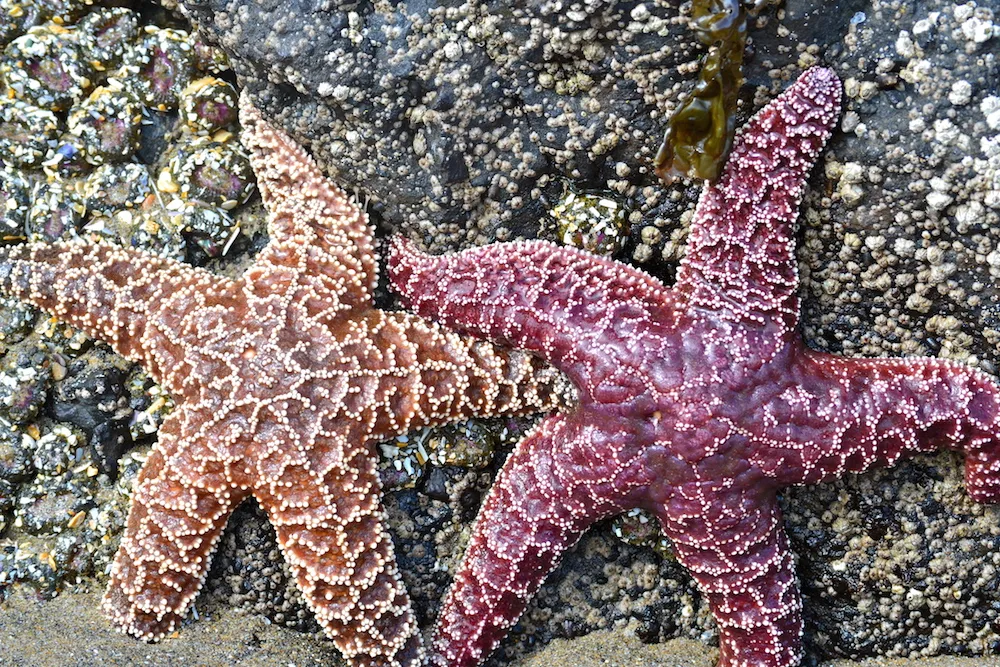
For the past four years, a mysterious syndrome has been killing millions of sea stars along the West Coast, turning the five-armed critters into piles of goo. But now, the sea stars appear to be making a comeback, according to news reports.
In Southern California and elsewhere, the palm-size sea stars are showing up in record numbers, compared with the past few years, The Orange County Register reportedon Tuesday (Dec. 26).
"They are coming back, big time," Darryl Deleske, an aquarist for the Cabrillo Marine Aquarium in San Pedro, told The Orange County Register. "It’s a huge difference … A couple of years ago, you wouldn’t find any. I dove all the way as far as Canada, specifically looking for sea stars, and found not a single one." [In Photos: Sick Sea Stars Turn to Goo]
Beginning in 2013, researchers discovered that West Coast sea stars were dying from the mysterious sea star wasting syndrome. Infected starfish developed lesions and fell apart, turning into gooey blobs.
It's unclear what causes the syndrome, but researchers suspect it may be a virus infecting sea stars from the coastal waters of Mexico all the way up to Canada and even Alaska, according to a map tracking the syndrome's spread. The syndrome has killed ochre stars, mottled stars, leather stars, sunflowers, rainbows and six-armed stars, according to the Associated Press.
However, the sea stars are bouncing back, at least in parts of Southern California. Moreover, last year scientists discovered a sea star baby boom blooming off the Oregon coast, Live Science previously reported.
The recent mass die-off isn't the first to strike West Coast sea stars. The region also experienced sea star population death spirals in the 1970s, 1980s and 1990s, although these die-offs were smaller and more geographically contained than the one that began in 2013, according to a report from the University of California, Santa Cruz.
Get the world’s most fascinating discoveries delivered straight to your inbox.
Although the news of the rebound is encouraging, the stars aren't out of the woods yet. The wasting syndrome is still infecting starfish in Northern and Central California, and it has returned to the Salish Sea, an area bordering northern Washington and southern British Columbia, according to the Santa Cruz report.
Original article on Live Science.

Laura is the managing editor at Live Science. She also runs the archaeology section and the Life's Little Mysteries series. Her work has appeared in The New York Times, Scholastic, Popular Science and Spectrum, a site on autism research. She has won multiple awards from the Society of Professional Journalists and the Washington Newspaper Publishers Association for her reporting at a weekly newspaper near Seattle. Laura holds a bachelor's degree in English literature and psychology from Washington University in St. Louis and a master's degree in science writing from NYU.