It's quick and easy to access Live Science Plus, simply enter your email below. We'll send you a confirmation and sign you up for our daily newsletter, keeping you up to date with the latest science news.
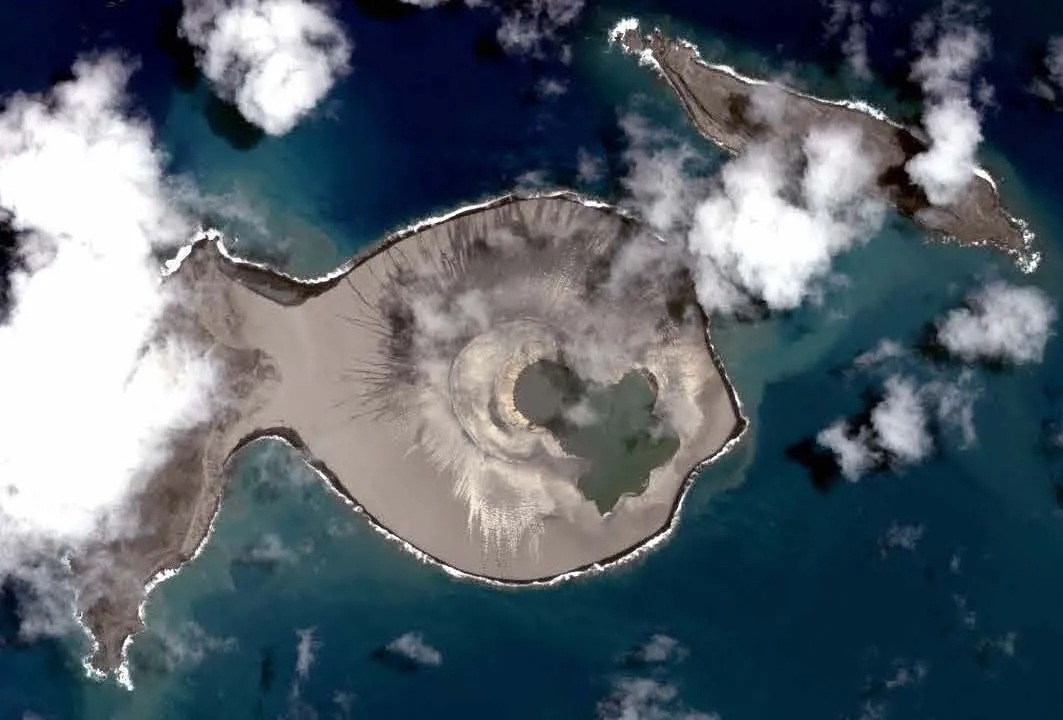
A baby island burst out of the South Pacific Ocean three years ago during a volcanic explosion in the Polynesian kingdom of Tonga, and now NASA scientists think it could be here to stay for decades.
When the new landmass, dubbed Hunga Tonga-Hunga Ha'apai, emerged out of a towering, 30,000-foot-high (9,100 meters) cloud of ash, researchers thought it would get washed away within weeks or months, according to a NASA statement. Now, NASA researchers believe the mound of new dirt, with its 400-foot (120 meter) summit, could last for many more years.
Hunga Tonga-Hunga Ha'apai is interesting, NASA scientist James Garvin explained in a video, because islands of its kind are "windows into the role of surface waters on Mars, as they have effected small landforms like volcanos — and we see fields of them on Mars." [The Harshest Environments on Earth]
Those landforms, he went on, once offered the conditions where early life on Mars may have formed: warm, watery, turbulent and salty.
This island was, in its first six months, very unstable. It eroded rapidly, changing shape constantly, NASA wrote. Observing it through monthly satellite images, researchers watched it shrink, and expected it to disappear entirely. Instead, over time, the conditions on the island stabilized as salt water interacted with loose volcanic dust to form firmer ground.
Researchers are still working to understand the exact chemical conditions that helped the island, and its surrounding landforms, to become resilient against erosion.
This view, shot on the island itself, shows the landform up close.
(Image credit: NASA/Damien Grouille/Cecile Sabau)
It remains perched, U-shaped, on the caldera of an underwater volcano (its creator) that itself stands 4,600 feet (1,400 meters) above the seafloor, NASA wrote. It includes an interior lake, walled off by a low sandbar that has collapsed in the past, but currently remains intact. The island could last another 6 to 30 years, according to NASA.
Sign up for the Live Science daily newsletter now
Get the world’s most fascinating discoveries delivered straight to your inbox.
Hunga Tonga-Hunga Ha'apai is just the third new island to emerge from a volcanic explosion in the last 150 years. For instance, in 2011, a volcanic eruption birthed an island in the Red Sea. Another underwater volcanic eruption, this one in November 2013, led to the formation of an island off Japan. These sorts of islands, called "surtseyan" after Surtsey, an earlier example near Iceland, are chemically and geologically distinct from the more common advent of islands formed by slower volcanic processes.
But because they represent a kind of landform that may have also formed in the ancient waters of Mars, scientists are deeply interested in their evolution.
Rafi joined Live Science in 2017. He has a bachelor's degree in journalism from Northwestern University’s Medill School of journalism. You can find his past science reporting at Inverse, Business Insider and Popular Science, and his past photojournalism on the Flash90 wire service and in the pages of The Courier Post of southern New Jersey.

 Live Science Plus