













Did Easter Islanders Have Early Contact with South Americans?

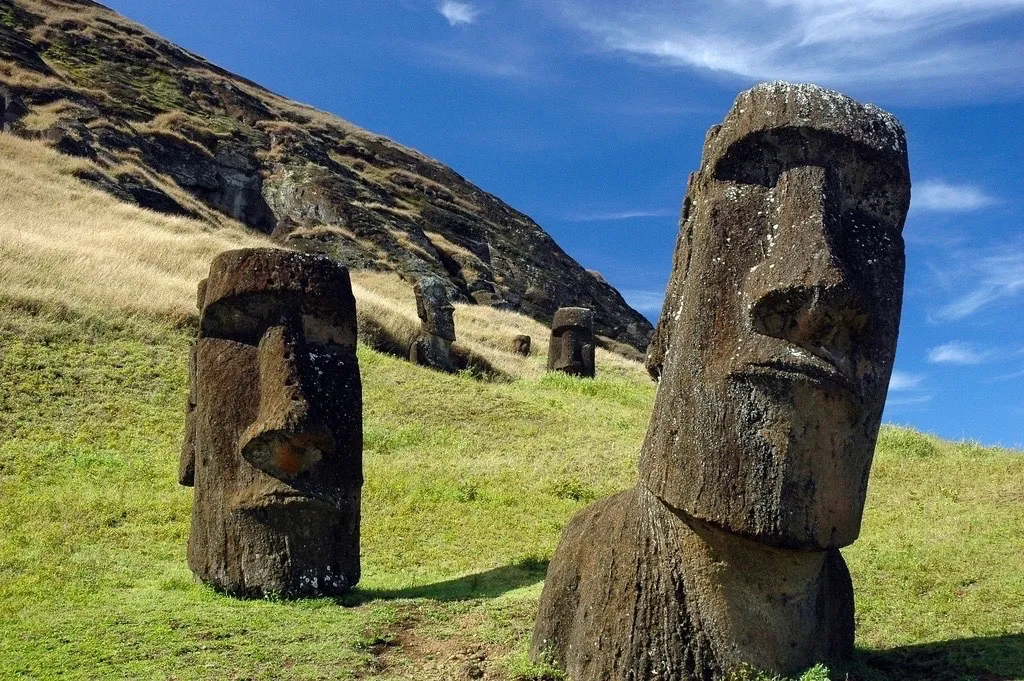
On a map, Easter Island is a remote dot more than 2,000 miles (3,219 kilometers) from the western coast of Chile. It has long fascinated archaeologists —not only for its hundreds of enormous statues, called moai, but also because it could hold clues about epic Pacific sea voyages and subsequent cultural mash-ups that occurred before the arrival of Europeans.
Most scholars think that Easter Island, also known by its native name Rapa Nui, was first populated by Polynesians who arrived around AD 1200. But there’s also some evidence that the island's early settlers interacted with people native to South America before Europeans showed up in 1722.
A new study, published yesterday (Oct. 12) in the journal Current Biology, adds to the debate. Scientists looked at five skeletons from the Rapanui culture and found no genetic traces of Native American ancestry, contradicting earlier assertions of contact with South American peoples. [Image Gallery: The Walking Statues of Easter Island]
"We were really surprised we didn't find anything," study leader Lars Fehren-Schmitz, an associate professor of anthropology at UC Santa Cruz, said in a statement. "There's a lot of evidence that seems plausible, so we were convinced we would find direct evidence of pre-European contact with South America, but it wasn't there."
Fehren-Schmitzand his colleagues took samples from the ribs of skeletons that were found in the 1980s during an archaeological digat the beachside moai site of Ahu Nau Nau. Some bones date back to as early as 1445, while others were buried as late as 1925, well after European contact. In all cases, no DNA traces of Native Americans were found.
The idea that South Americans first populated Easter Island was proposed in the 1950s by Thor Heyerdahl, the Norwegian anthropologist famous for his Kon-Tiki raft expedition. He saw sweet potatoes native to the Andes growing on Rapa Nui, and noticed similarities between fishing gear, language quirks and pre-Inca stone statueson the island and the mainland.
Today, the archaeological consensus is that Polynesians —who were skilled at long-distance ocean voyages and settled scattered Pacific islands—got to Rapa Nui first. But scholars haven’t totally tossed out Heyerdahl’s idea about early contact with South America.
Get the world’s most fascinating discoveries delivered straight to your inbox.
Erik Thorsby of the University of Oslo, who was not involved in the new study, previously found some genetic markers typical of Native Americans in Rapanui skeletons.
Based on a recent review of the evidence, Thorsby suggested that Native Americans may have arrivedat Rapa Nuias early as AD 1280 to 1495, perhaps by hitching a ride with Polynesians who were returning from visits to the shores of South America.
Thorsby said he thinks the new findings are interesting, but added that "great caution must be exercised in drawing general conclusions since ancient DNA from only five different individuals was studied." He noted that past studies have revealed small percentages of early Native American ancestry in just a few individuals from the island. Therefore, it’s possible that only a few Native Americans reached Rapa Nui early and their ancestral genes "may be easily missed when ancient DNA from only five individuals are investigated," he told Live Science in an email.
Original article on Live Science.
