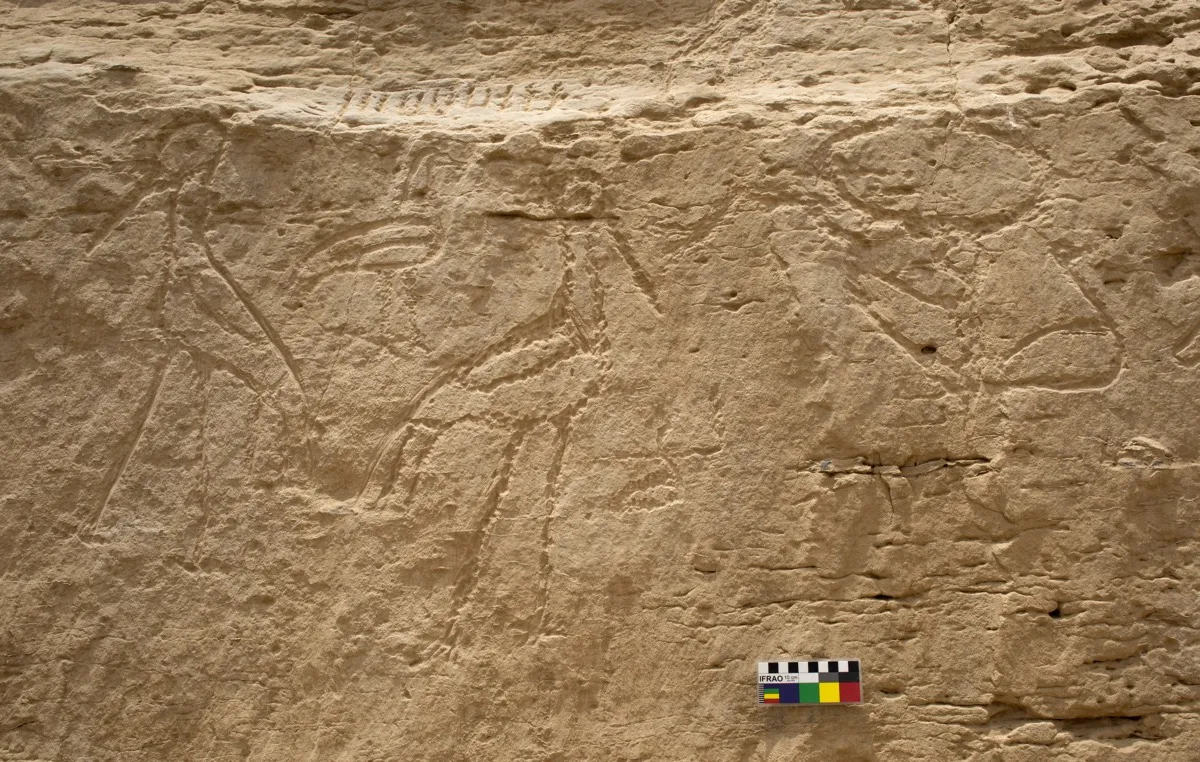
Archaeologists have discovered a "billboard" of hieroglyphs carved into the rocks near the Egyptian village of El-Khawy. The symbols, which show a message related to the cosmos, are the earliest monumental (large) hieroglyphs known, dating back around 5,200 years.
"This newly discovered rock art site of El-Khawy preserves some of the earliest — and largest — signs from the formative stages of the hieroglyphic script and provides evidence for how the ancient Egyptians invented their unique writing system," John Darnell, a professor at Yale University who co-directs the expedition that discovered the rock art, said in a statement from Yale University. The Egyptian antiquities ministry also issued a statement today (June 22) announcing the discovery.
The archaeologists also discovered another carving, this one showing a herd of elephants, created sometime between 4000 B.C. and 3500 B.C. One of the adult elephants in the scene was drawn with a little elephant inside its body — "an incredibly rare way of representing a pregnant female animal," Darnell said in the Yale statement. [Photos: 5,000-Year-Old Hieroglyphs Discovered in Sinai Desert]
Only a few similar scenes are known from Egypt. For example, a vase previously found at the site of Abydos depicts a pregnant hippopotamus, Darnell told Live Science.
In this rock carving, a little elephant is shown inside an adult elephant, an indication that the animal is pregnant. It was carved sometime between 4000 B.C. and 3500 B.C.
(Image credit: Courtesy of Yale University)
Political message
The four early hieroglyphic signs were carved around 3250 B.C. And the carvers seemed to be making a statement, as the symbols are about 70 centimeters (27.5 inches) high and had "abright, almost white, color against the patina of the surrounding brown stone" after they were freshly carved, Darnell told Live Science.
"In the modern world, this would be akin to seeing smaller text on your computer screen and then suddenly seeing very large ones made the same way only on a billboard," Darnell said in the Yale statement.
One of the signs shows a bull's head on a short pole, a symbol found at other Egyptian sites. "The bull's head appears to be a symbol of royal power during the formative phases of the Egyptian state," Darnell told Live Science.
Curious about Life's Little Mysteries?
Feed your curiosity with an exclusive mystery every week, solved with science and delivered direct to your inbox before it's seen anywhere else.
John Darnell, of Yale University, who co-directs the expedition that discovered the rock carvings, is shown here at the site, called El-Khawy.
(Image credit: Courtesy of Yale University)
The other three signs show two storks, back-to-back, with a bald ibis bird in between them. The stork-ibis-stork arrangement suggests that those three signs are making a "statement about the cosmos through the solar cycle," Darnell told Live Science, noting that similar arrangements of symbols can be seen at other Egyptian sites.
Together, the four symbols were likely "an expression of royal authority over the ordered cosmos," Darnell said, adding that the "inscription was visible to travelers going to and from the early city of Elkab."
The hieroglyphs would have been visible to anyone who passed by during this time, suggesting that many ancient Egyptians were able to understand the signs, Darnell said.
The rock carvings were discovered by a joint expedition from Yale and the Royal Museums of Art and History, in Brussels. The expedition team works in collaboration with the Egyptian antiquities ministry.
Owen Jarus is a regular contributor to Live Science who writes about archaeology and humans' past. He has also written for The Independent (UK), The Canadian Press (CP) and The Associated Press (AP), among others. Owen has a bachelor of arts degree from the University of Toronto and a journalism degree from Ryerson University.