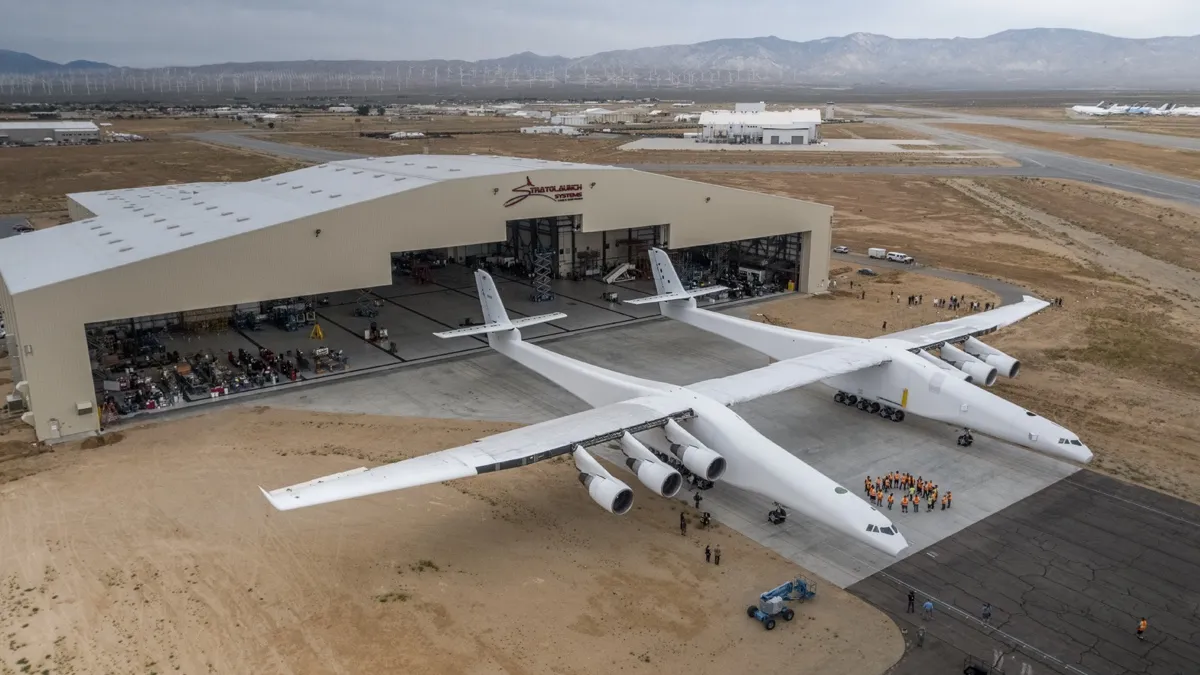
The Stratolaunch aircraft, which weighs about 500,000 pounds (227,000 kilograms) moved out of the hangar to conduct aircraft fueling tests on May 31, 2017.
A bizarre, double-bodied airplane with the largest wingspan of any aircraft in the world just rolled out of its hangar for the first time.
The Stratolaunch aircraft is designed to carry satellites into low-Earth orbit. The aircraft will carry satellites and their launch vehicles to a cruising altitude of 36,000 feet (11,000 meters) or so, according to Paul G. Allen, the founder of Stratolaunch. From there, the aircraft becomes something like a mobile launch pad, releasing the satellites and their launchers into orbit before returning to the runway. The advantage, according to Allen, is that getting satellites into orbit would become easier and faster. No longer would scientists or governments have to wait for a rocket launch from the ground; the Stratolaunch plane could take off from many runways and fly for hundreds of miles to find good weather conditions.
The strange dual fuselages of the craft each have a role. The right fuselage is for the flight crew, according to the company, and the left fuselage houses flight data systems. The payload will be carried underneath the conjoined center wing. Six 747 engines will lift the craft off the ground, and 28 wheels will allow for runway-style takeoffs and landings.
Now, construction of this mobile satellite launcher has advanced enough to move the Stratolaunch craft out of the hangar for its first round of testing. Today (May 31) marks the first time the plane has left the hangar, and also the first time the aircraft has held its own weight, according to a company statement — Until now, the aircraft has been partially supported by scaffolding and other infrastructure used for constructing the giant plane.
Six 747 engines will lift the Stratolaunch off the ground.
(Image credit: Stratolaunch Systems Corp.)
The craft's wingspan measures 386 feet (118 m) across, 26 feet (8 m) longer than a professional football field. That makes the Stratolaunch plane the largest in the world by wingspan. From nose to tail, the plane is 238 feet (76 m) long. It's taller than a four-story building from the ground to the tallest point of its tail, which towers 50 feet (15 m) high. The Airlander 10, a helium-filled airship, is considered the world's longest aircraft currently flying, extending 302 feet (92 m) long. [In Photos: Building the World's Largest Airship (Airlander 10)]
The craft weighs in at 500,000 pounds (nearly 227,000 kilograms) and is designed to carry payloads of another 550,000 lbs. (nearly 250,000 kg). The first planned launch will be a single Orbital ATK Pegasus XL vehicle, a pre-existing rocket that can launch from carrier aircrafts. The company hopes to demonstrate such a launch in early 2019.
For now, the Stratolaunch team is conducting fueling tests, after which the craft will go through engine runs, ground testing and taxi testing before the first flight test.
Sign up for the Live Science daily newsletter now
Get the world’s most fascinating discoveries delivered straight to your inbox.
Stephanie Pappas is a contributing writer for Live Science, covering topics ranging from geoscience to archaeology to the human brain and behavior. She was previously a senior writer for Live Science but is now a freelancer based in Denver, Colorado, and regularly contributes to Scientific American and The Monitor, the monthly magazine of the American Psychological Association. Stephanie received a bachelor's degree in psychology from the University of South Carolina and a graduate certificate in science communication from the University of California, Santa Cruz.