













Humans May Have Occupied North America 100,000 Years Earlier Than Thought

Early humans may have lived on the North American continent 130,000 years ago, more than 100,000 years earlier than scientists previously believed, according to a new study. The research examined ancient mastodon bones that bore "conclusive" signs of being handled by intelligent beings, the researchers said.
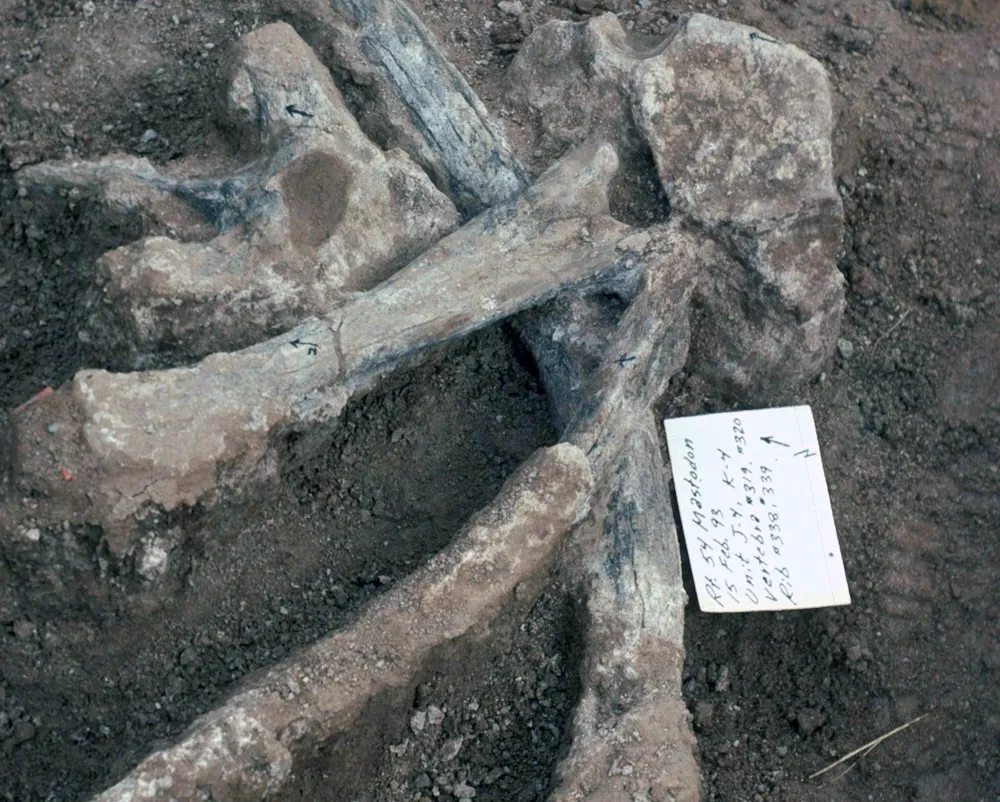
When a new freeway was being constructed near San Diego in the early 1990s, one of the excavators hit what seemed like an ancient pile of animal bones. Palaeontologists called to the site confirmed that the bones belonged to a long-extinct Pleistocene mastodon, a significant discovery on its own.
But more than 20 years later, the site, called Cerutti (after one of its discoverers Richard Cerutti of San Diego Natural History Museum), may be rewriting the understanding of human presence in the New World. The arrangement of the bones at Cerutti suggests the early appearance of humans at the site, the researchers said. [In Photos: 130,000-Year-Old Evidence of Humans in California]
"The bones were positioned in quite an unusual way," said Thomas Deméré, a paleontologist at the San Diego Natural History Museum and lead author of the new study. "For example, one tusk was positioned vertically. Femur heads were found side by side in very distinct clusters, and the bones were fractured in a spiral way, which led us to believe that humans must have been processing those mastodon limb bones."
Examining the bones
The layer of finely grained sand silt holding the bones was completely intact, but within it, the researchers found several large cobbles with signs of wear. This indicates that the cobbles must have been used as hammers and anvils to process the bones, the researchers said.
The geological conditions of the site led the researchers to think it must be more than 15,000 years old, thus preceding when Homo sapiens were thought to have lived in North America. Attempts to establish the age of the site using radiocarbon dating failed, because there was no collagen preserved in the bones, the scientists said. But in 2012, James Paces, a uranium-dating expert at the U.S. Geological Survey, received the bones. The results he obtained surprised the researchers.
"I used a method called uranium series disequilibrium dating, which uses radioactive decay of naturally occurring uranium, and the initial results suggested that those [bones] might have been 110 [thousand] and 120 thousand years old," Paces told reporters Tuesday (April 25) in a media briefing.
Get the world’s most fascinating discoveries delivered straight to your inbox.
Skeptical about the results, Paces and his colleagues continued analyzing the bones. The researchers performed more than 100 analyses of bones, tooth enamel and ivory found at the site. The results kept pointing to the same age, the researchers said. [The 25 Most Mysterious Archaeological Finds on Earth]
"We came up with a result of the estimated age of about 130,000 plus [or] minus 9,000 years, which represents the average of multiple analyses of cross sections of three separate specimens," Paces said.
Wear and tear
During the press briefing, the researchers dismissed suggestions that heavy machinery used during the freeway construction could have broken the bones. The only way such patterns could have been produced was if the bones were broken when fresh, the researchers said. To confirm this hypothesis, the team dug up an elephant corpse and set out to smash its bones using tools similar to those found at the site.
"We produced exactly the same fracture patterns that we see on these mastodon limb bones," said Steven Holen, an archaeologist at the Center for American Paleolithic Research.
Deméré added that while the large limb bones were distinctively damaged, more fragile pieces of the mastodon skeleton, such as ribs and vertebrae found at the site, were completely intact.
Humans in Africa were already making tools from the bones of large animals 1.5 million years ago, Holen said. The knowledge of such technology would therefore be known to the pre-historic American settlers and would explain why they only focused on the large useful bones.
"These bones were not broken by carnivore chewing. They were not broken by other animals trampling on these bones," he said. "When we eliminate all of the other natural processes and reproduce the results experimentally, we have very strong evidence."
Changing the paradigm
The researchers, however, said they expect the scientific community to be skeptical of the findings. Most scientists think that humans made it to the American West Coast only 15,000 years ago, which is 115,000 years later than what the new study concludes. [Gallery: See Images of Our Closest Human Ancestor]
"The team's conclusions are paradigm-shifting, and I'm sure they will come under a lot of scrutiny in the coming days and months. And so they should, as archaeology moves forward by discovery, interpretation and testing of the evidence," Matt Pope, principal research associate in palaeolithic archaeology and a senior geoarchaeologist at theInstitute of Archaeology of University College London, told Live Science in an email.
"What's for certain is archaeologists will now be looking at earlier deposits in North America with closer interest," Pope said. "A claim like this can never rest easily on a single site, but the team [has] presented evidence which can't be ignored. They have opened up the possibility of a new, astonishing[ly] early and continental-scale episode of hominin [human species] dispersal."
Holen said that finding human remains from the period at the Cerutti site but also anywhere else in the U.S. is unlikely. Very few human remains have been discovered in the U.S. of human cultures only 13,000 years old and population densities of the early arrivals were extremely low, he added.
The researchers said they can only speculate who these early Americans were, where they came from, and whether the population survived and later mixed with newer arrivals or became completely extinct.
The new findings were published online today (April 26) in the journal Nature.
Original article on Live Science.
