













What's Cookin'? Nothing, If You Were an Early Human

About a million years before steak tartare came into fashion, Europe's earliest humans were eating raw meat and uncooked plants. But their raw cuisine wasn't a trendy diet; rather, they had yet to use fire for cooking, a new study finds.
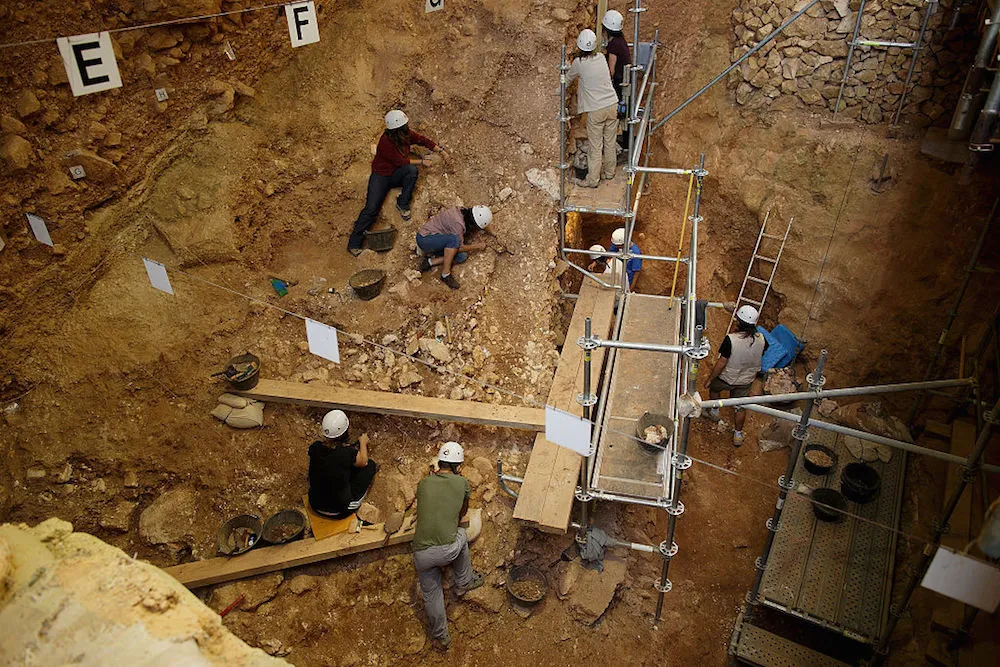
The finding is based on a dental plaque analysis from a 1.2-million-year-old hominin, an early human, excavated from Sima del Elefante (Pit of the Elephant) in northern Spain. In 2007, the Atapuerca research team took samples of the dental plaque from a hominin molar, and later a team of archaeologists extracted microfossils from the plaque so they could learn more about the diet of early humans.
The microfossils included traces of raw animal tissue, uncooked starch granules (suggesting that the hominin ate grasses and a species of pine), insect fragments and a possible toothpick sliver, the researchers said. [In Photos: Hominin Skulls with Mixed Traits Discovered]
All of the fibers in the plaque were uncharred, and researchers found no evidence of microcharcoal inhalation, usually a sign that an individual was near a fire, they said.
"Obtaining evidence for any aspect of hominin life at this extremely early date is very challenging," the study's lead author, Karen Hardy, an honorary research associate at the University of York in England, said in a statement. "Here, we have been able to demonstrate that these earliest Europeans understood and exploited their forested environment to obtain a balanced diet 1.2 million years ago, by eating a range of different foods and combining starchy plant food with meat," added Hardy, who is also a research professor at the Universitat Autònoma de Barcelona in Spain.
It's not entirely clear when human ancestors first used fire for cooking. Some researchers say that early humans were regularly tending fires about 1.8 million years ago, but others say habitual use of fire didn't begin until about 300,000 to 400,000 years ago, according to excavations showing concentrated ash and charcoal, sediments reddened by heat, rocks scarred by heat and burned bones, Live Science reported in 2011.
There is suggestive evidence of fire at early human sites in Africa, according to a 2013 study in the journal Azania: Archaeological Research in Africa, but that knowledge apparently wasn't transmitted to Europe (or, at least, Sima del Elefante) when the earliest humans left Africa, said the researchers of the new study.
Get the world’s most fascinating discoveries delivered straight to your inbox.
The earliest evidence for human-tended fires in Europe dates to 800,000 years ago at Cueva Negra (in Spain) and a short time later at Gesher Benot Ya'aqov (in Israel).
Given that the early humans at Sima del Elefante likely didn't have fire 1.2 million years ago, awareness of fire technology probably occurred sometime between 1.2 million and 800,000 years ago in Europe, the researchers said.
"This new timeline has significant implications in helping us to understand this period of human evolution," Hardy said. "Cooked food provides greater energy, and cooking may be linked to the rapid increases in brain size that occurred from 800,000 years ago onwards."
In addition, the new timeline fits with research suggesting that cooking with fire is linked to the development of salivary amylase, which breaks down starch, Hardy said. "Starchy food was an essential element in facilitating brain development, and contrary to popular belief about the 'Paleodiet,' the role of starchy food in the Palaeolithic diet was significant," she said. [Top 10 Mysteries of the First Humans]
The findings are "exciting," said study co-author Anita Radini, a doctoral student of archaeology at the University of York.
"They highlight the potential of dental calculus to store dietary and environmental information from deep in the human evolutionary past," Radini said. "It is also interesting to see that pollen remains are preserved often in better conditions than in the soil of the same age."
The study was published online Dec. 15 in the journal The Science of Nature.
Original article on Live Science.

Laura is the managing editor at Live Science. She also runs the archaeology section and the Life's Little Mysteries series. Her work has appeared in The New York Times, Scholastic, Popular Science and Spectrum, a site on autism research. She has won multiple awards from the Society of Professional Journalists and the Washington Newspaper Publishers Association for her reporting at a weekly newspaper near Seattle. Laura holds a bachelor's degree in English literature and psychology from Washington University in St. Louis and a master's degree in science writing from NYU.