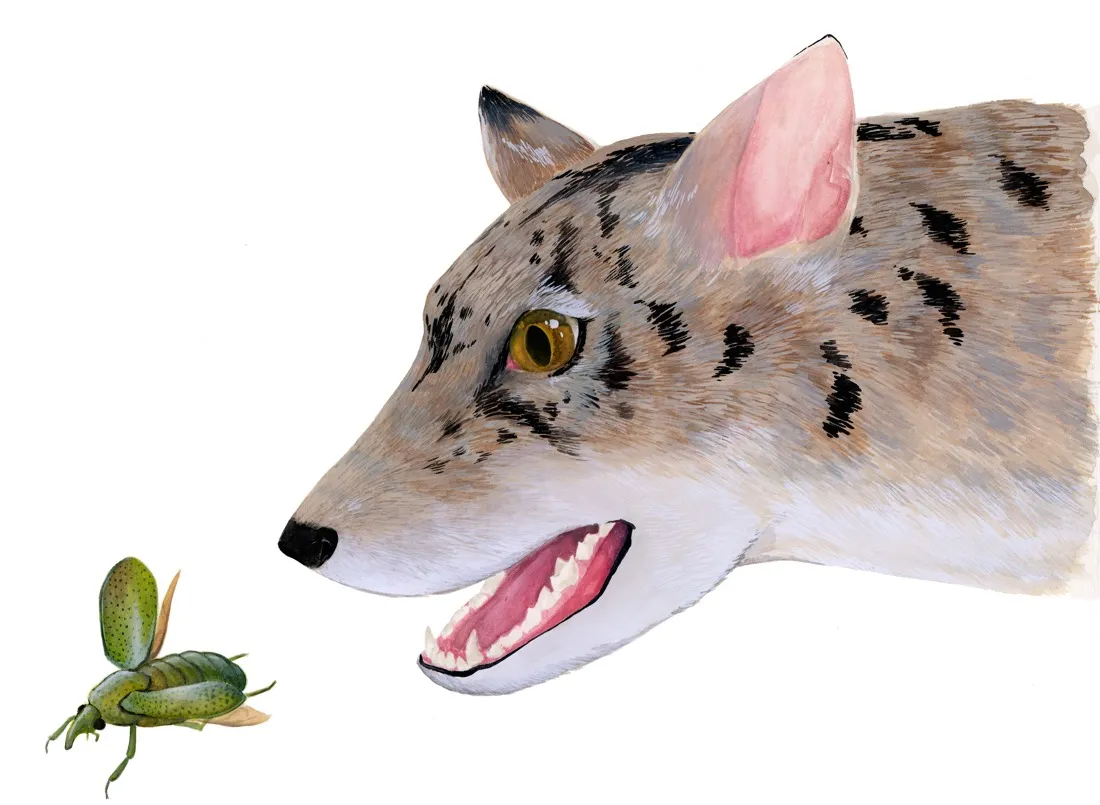
Artist's reconstruction of an early beardog (from about 38 million years ago) from Texas, based on fossils of Angelarctocyon australis and Gustafsonia cognita.
(Image credit: copyright Monica Jurik, The Field Museum)
A group of Chihuahua-size "beardogs" have new names a mere 37 million years after they went extinct.
Beardogs, or amphicynids, were carnivores that ranged in size from just a few pounds to well over 1,000 lbs. (450 kilograms). Texas was home to some of the earliest members of this group, including two species of tiny beardog that have been reclassified with new scientific names.
"We've known about these curious little critters for 30 years, but couldn't tell exactly what kind of carnivores they were," study researcher Susumu Tomiya, a postdoctoral scholar at the Field Museum in Chicago, said in a statement. Tomiya and his colleagues reported their findings today (Oct. 11) in the journal Royal Society Open Science. [6 Extinct Animals That Could Be Brought Back to Life]
Tomiya had just started working at the Field Museum when he noticed that a couple of small carnivore jaws in the mammal collection seemed wrongly categorized. Both were small beardogs that lived about 37 million or 38 million years ago in what is now Texas.
"The genus the specimen had been assigned to didn't seem to fit some of the features on the teeth," Tomiya said.
The two jaw specimens were called Miacis australis and Miacis cognitus, and both had flat surfaces along the upper teeth that would have been used for crushing, rather than just ripping or tearing. These features made Tomiya think that the animals weren't pure carnivores, but also ate things like berries and insects. The teeth also looked similar to those seen in later, larger beardogs, Tomiya thought.
The newly reclassified beardog Angelarctocyon australis (Field Museum specimen no PM 423) had a much smaller jawbone (left) than that of the larger Amphicyon riggsi (right, Field Museum specimen no. P 12029), which lived around 22 million years later.
(Image credit: copyright Susumu Tomiya, The Field Museum)
He and his colleagues used high-resolution X-ray computed tomography (CT) scanning to digitally reconstruct the jaws and skull fragments of the two animals. The high-definition digital reconstructions allowed them to compare internal anatomical features, like the cavity where the inner ear would have been,with the anatomy of other beardogs.
Sign up for the Live Science daily newsletter now
Get the world’s most fascinating discoveries delivered straight to your inbox.
As a result, the researchers renamed the two beardogs. Miacis cognitus became Gustafsonia cognita, and Miacis australis became Angelacrtocyon australis.
The name change matters because it helps clarify the early evolutionary history of beardogs. These animals are part of the same group as dogs, wolves, bears, foxes, sea lions and weasels.
"They're equally related to all of the dog relatives alive today," Tomiya said. "They're not the direct ancestors of modern wolves and bears, but more like their cousins."
The two Texas beardogs were among the earliest species of beardog to evolve, Tomiya said, and their rediscovery suggests that the southern part of North America may have been more important to beardog evolution than previously believed. The two species lived during a climate transition from subtropical to cooler and dryer, Tomiya said, and the fossils hint at the kind of animals that thrived in that time of change. The beardogs' change from small to large is also a common pattern in vertebrate evolution, Tomiya said.
"Studying how the diversity of beardogs waxed and waned over time could tell us about larger patterns of carnivore evolution," he said.
Stephanie Pappas is a contributing writer for Live Science, covering topics ranging from geoscience to archaeology to the human brain and behavior. She was previously a senior writer for Live Science but is now a freelancer based in Denver, Colorado, and regularly contributes to Scientific American and The Monitor, the monthly magazine of the American Psychological Association. Stephanie received a bachelor's degree in psychology from the University of South Carolina and a graduate certificate in science communication from the University of California, Santa Cruz.