













Coral and Brittle Star: 'Til Death Do Us Part
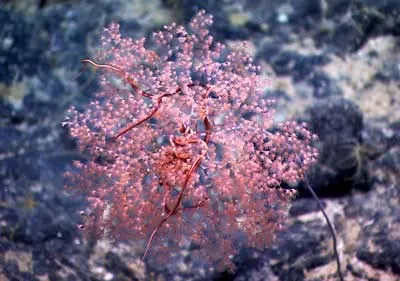
The deep-sea coral Metallogorgia melanotrichos resembles a tree inspired by Dr. Seuss, with pink leaves and a long, thin trunk. Within that cotton-candy canopy, every coral harbors a single brittle star, Ophiocreas oedipus. Both species have been known to science for more than a century, but until recently no one had noticed their exclusive lifelong partnerships.
Celeste V. Mosher and her graduate adviser Les Watling, both then at the University of Maine’s Darling Marine Center in Walpole, discovered the relationship during a series of deep dives, using submarines and remotely operated vehicles, along a New England seamount chain. Watling also later observed the coral–brittle star couples in the Bahamas.
The team documented more than 150 pairs in various life stages — but never a lone M. melanotrichos or O. oedipus.
The youngest coral they found was a wisp five inches long with a tiny brittle star wound around it. Teenage corals each housed a medium-size star. And every mature coral, about three feet tall, had a big star entangled in its pink canopy. One dead coral retained an old star, still clinging tight.
The researchers think larval brittle stars probably settle on young corals, and the pair ages together until death do them part, several decades on. The corals may provide brittle stars with shelter among their toxic polyps and access to food above the seafloor. What, if anything, the brittle stars give back remains unclear, but Watling thinks a few other species of coral and brittle star may prove similarly intimate.
The findings were detailed in the Marine Ecology Progress Series.
Get the world’s most fascinating discoveries delivered straight to your inbox.