













Multitasking During Exercise May Ramp Up the Workout
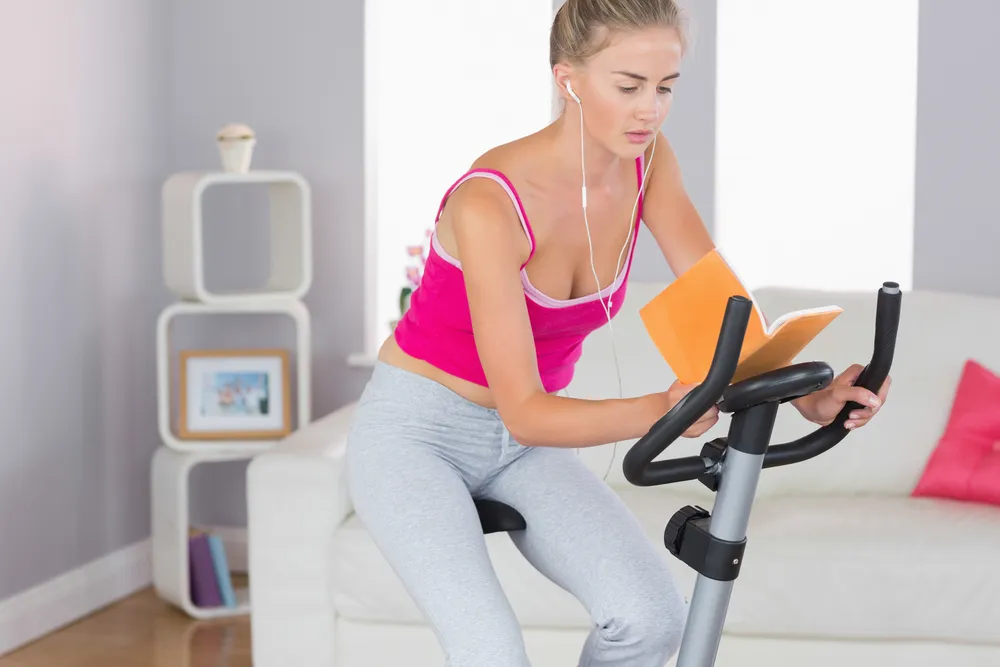
Trying to do multiple things at once can have mixed results; you may accomplish more, or you may not get anything done. When it comes to exercising, though, multitasking may be a good idea, a new study suggests.
In the study of older adults, researchers found that, when people completed easy cognitive tasks while they were cycling on a stationary bike, their cycling speed increased.
The investigators said the results surprised them. "Every dual-task study that I'm aware of shows that, when people are doing two things at once, they get worse" at those tasks, study author Lori Altmann, an associate professor of speech, language and hearing sciences at the University of Florida, said in a statement. "Everybody has experienced walking somewhere in a hurry when the person in front of them pulls out a phone, and that person just slows to a crawl."
In the study, the researchers looked at 20 healthy adults whose average age was 73, and 28 people with Parkinson's disease, whose average age was 66. The participants completed 12 cognitive tasks while they were sitting in a quiet room, and then they did the tasks again as they were cycling. The easiest tasks included saying the word "go" whenever a blue star appeared on a projection screen, and the most difficult tasks involved repeating long lists of numbers in the reverse order in which they were given. The researchers recorded the people's cycling speed using a video motion-capture system.
In the healthy group, the participants sped up by about 25 percent on average when they were doing the easiest tasks. "Some of the people in that group actually doubled their speed during that task," Altmann told Live Science.
The people with Parkinson's disease also sped up while performing the easiest tasks, but not as much as the people in the healthy group, the study found. [10 Ways to Keep Your Mind Sharp ]
However, all of the participants decreased their speed as the tasks became more difficult. Still, the speeds at which the people cycled while doing the most difficult cognitive tasks were about the same as the speeds at which they cycled before they began the tasks, the researchers said.
Get the world’s most fascinating discoveries delivered straight to your inbox.
It is not exactly clear why doing an easy task appeared to help people cycle faster, but the explanation may have something to with the release of certain neurotransmitters in the brain, the researchers said. During exercise, the brain releases two such neurotransmitters, dopamine and noradrenaline, which speed up people's thinking and reaction times, Altmann said.
Research also has shown that those same neurotransmitters are released when a person is exposed to novel and challenging tasks. The researchers think that these two venues of neurotransmitter release may improve the efficiency of the brain, and thus boost both motor and cognitive performance, they said.
In the future, the researchers would like to see if they could use their findings to get older adults to exercise more intensely, Altmann said. A lot of older adults have started exercising in recent years, and some may be encouraged by research showing that exercise may improve people's thinking skills. But some people do not exercise intensely enough to gain health benefits from aerobic exercise because they don't like to get sweaty, Altmann said.
The people in the study did not even realize they were cycling faster, and therefore exercising more intensely, when they were doing the cognitive tasks, she said. If researchers could figure out a way to convert the concept of the study into a game format, they could perhaps get older people to increase the intensity of their workouts, Altmann said.
The study was published May 13 in the journal PLOS ONE.
Follow Agata Blaszczak-Boxe on Twitter. Follow Live Science @livescience, Facebook & Google+. Originally published on Live Science.