














Rehab Exoskeleton is First of Its Kind (Video)
Dena Headlee, audio visual production specialist at the U.S. National Science Foundation (NSF) contributed this article to Live Science's Expert Voices: Op-Ed & Insights.
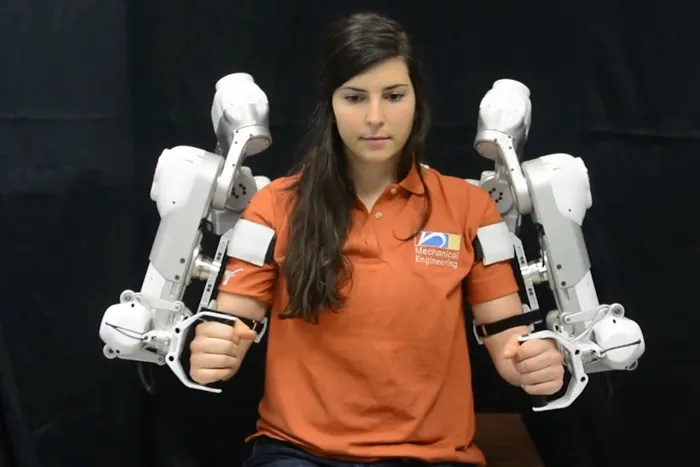
HARMONY, a first-of-its-kind, two-armed, robotic rehabilitation exoskeleton is upgrading rehabilitation. Developed by researchers at the Cockrell School of Engineering at the University of Texas at Austin, HARMONY is a two-armed, exoskeleton that fits over the entire upper body, connecting to the patient in three places.
"This robot is designed to deliver physical therapy and aid neurological disorders such as stroke or spinal cord injury," said lead developer Ashish Deshpande. HARMONY uses mechanical feedback and sensor data to provide therapy to patients with spinal cord and neurological injuries.
The researchers began the project in 2011, and realized they needed to develop a way to deliver full upper-body therapy by moving patients through their full range of natural motion. [Robotic Exoskelton Could Help People Walk ]
Reaching out to a program at NSF that specializes in information and intelligent systems, the researchers received a grant to design and develop a prosthetic robot with programmable passive dynamics.
The researchers expect the exoskeleton will be customizeable to an individual's therapy needs, reducing recovery time. And, using HARMONY's sensors and software, the system will allow therapists and doctors to deliver precise therapy while tracking and analyzing data. With HARMONY now complete, the team continues to develop the software and prepare for upcoming trials on patients.
Follow all of the Expert Voices issues and debates — and become part of the discussion — on Facebook, Twitter and Google+. The views expressed are those of the author and do not necessarily reflect the views of the publisher. This version of the article was originally published on Live Science.
Get the world’s most fascinating discoveries delivered straight to your inbox.