













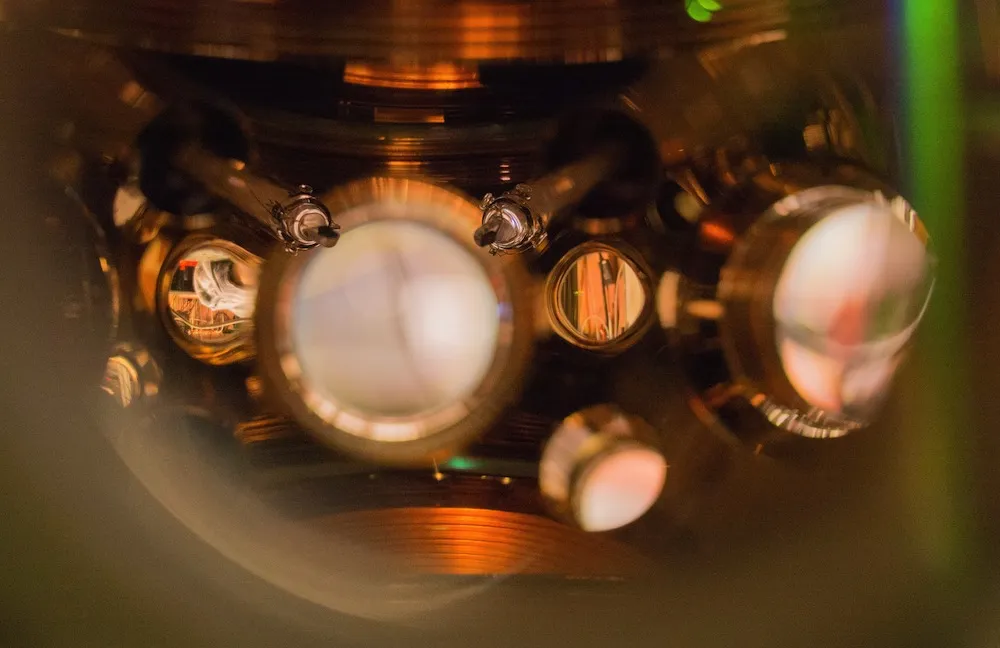
An atomic clock that sets the time by the teensy oscillations of strontium atoms has gotten so precise and stable that it will neither gain nor lose a second for the next 15 billion years.
The strontium clock, which is about three times as precise as the previous record holder, now has the power to reveal tiny shifts in time predicted by Einstein's theory of relativity, which states that time ticks faster at different elevations on Earth. That precision could help scientists create ultradetailed maps of the shape of the Earth.
"Our performance means that we can measure the gravitational shift when you raise the clock just 2 centimeters [0.79 inches] on the Earth's surface," study co-author Jun Ye, a physicist at JILA, a joint institute of the National Institute of Standards and Technology and the University of Colorado, Boulder, said in a statement.
The team also improved how closely the ticks matched one another, a metric called its stability, by almost 50 percent. [5 of the Most Precise Clocks Ever Made]
Insane precision
Atomic clocks typically work by measuring the vibrational frequency of atoms, such as strontium or cesium, as the atoms jump between different energy levels. Every atom naturally oscillates at very high frequencies billions or trillions of times per second. Counting these regular beats provides a highly precise measure of time. Currently, a cesium clock at NIST defines the second, where 1 second is 9,192,631,770 oscillations of the cesium atom.
In the new clock, thousands of strontium atoms at extremely cold temperatures are essentially pinned into a narrow column by intense laser light. To measure time, the clock hits those atoms with just the right frequency of red laser light to make the atoms jump energy levels. The previous version of the clock used a similar technique.
Get the world’s most fascinating discoveries delivered straight to your inbox.
On this occasion, however, the researchers improved the design by eliminating measurement errors related to an external source of electromagnetic radiation known as blackbody radiation, which is given off by opaque objects held at constant temperatures. The team placed radiation shields around the device, as well as platinum thermometers inside the clock's vacuum tube, to better account for the extra heat. The researchers also improved their calculations of how much radiation would be generated.
The new clock can also be operated at room temperature, as opposed to the cryogenic temperatures used in past versions.
"This is actually one of the strongest points of our approach, in that we can operate the clock in a simple and normal configuration while keeping the blackbody radiation shift uncertainty at a minimum." Ye said. (Blackbody radiation can affect the atom's energy level, which then affects the tick rate.)
The new record holder won't lose a second over the current age of the universe. But strontium atoms beat at 430 trillion times per second, so theoretically, at least, there's room for more improvement.
Relativistic measurements
The new clock is so precise that it can detect relativity in action at incredibly small scales. In a concept known as gravitational time dilation, time passes more quickly in weaker gravitational fields, so the higher the altitude on Earth, the lower the gravity is there — and the faster time is passing. The current clock is so sensitive that it could detect these effects with elevation changes as little as that caused by putting a small book under the clock.
If the clock can improve further, that would enable more detailed measurements of the Earth's shape. Currently, instruments like tidal gauges and gravimeters perform this task.
The findings were published today (April 21) in the journal Nature Communications.
Follow Tia Ghose on Twitterand Google+. Follow Live Science @livescience, Facebook & Google+. Originally published on Live Science.

Tia is the editor-in-chief (premium) and was formerly managing editor and senior writer for Live Science. Her work has appeared in Scientific American, Wired.com, Science News and other outlets. She holds a master's degree in bioengineering from the University of Washington, a graduate certificate in science writing from UC Santa Cruz and a bachelor's degree in mechanical engineering from the University of Texas at Austin. Tia was part of a team at the Milwaukee Journal Sentinel that published the Empty Cradles series on preterm births, which won multiple awards, including the 2012 Casey Medal for Meritorious Journalism.