













What's Next for the World's Largest Atom Smasher? How to Watch Live

Physicist Jon Butterworth, who works at the world's largest atom smasher, is intimately familiar with the drama that surrounded the 2012 discovery of the Higgs boson. Butterworth will recount the trials and tribulations in the hunt for "the most wanted particle," in a lecture tonight (April 1) at the Perimeter Institute for Theoretical Physics in Waterloo, Canada.
The event will be webcast live online, and you can tune in on Live Science starting at 7 p.m. ET.
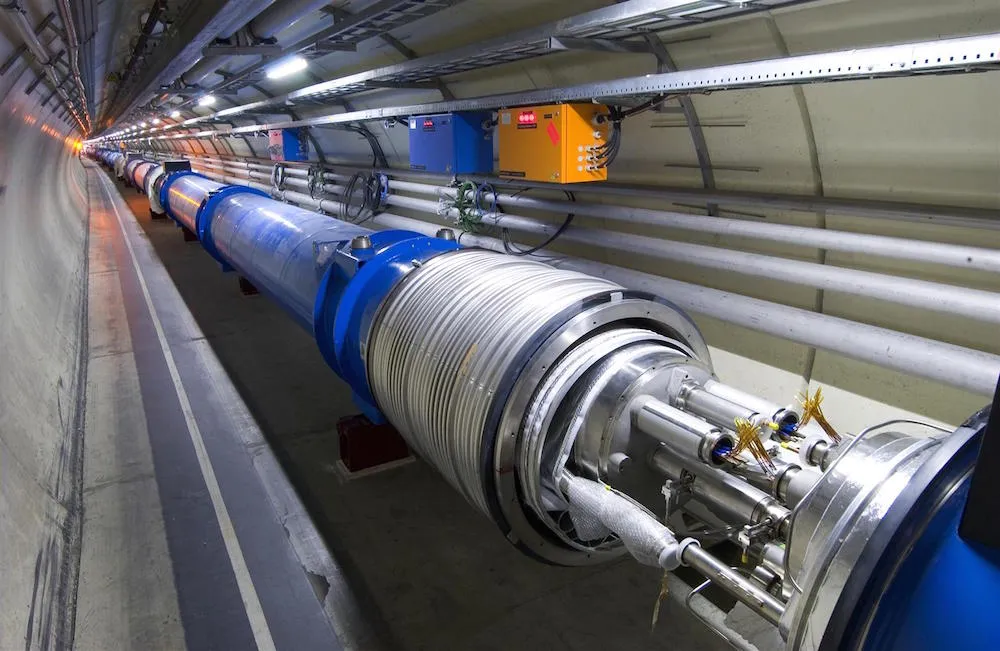
Butterworth is a physics professor at University College London in the United Kingdom, and a researcher at the European Organization for Nuclear Research (CERN), which manages the Large Hadron Collider (LHC), a ring-shaped particle accelerator located underground near Geneva, Switzerland. [See photos of the Large Hadron Collider]
In 2012, scientists at the LHC found evidence of the long-sought Higgs boson, an elementary particle that is thought to explain how other particles get their mass.
The discovery was considered a major breakthrough, and bolstered the Standard Model, which is the reigning theory of particle physics. Peter Higgs and François Englert, two of the physicists who, decades earlier, predicted the existence of the Higgs boson, went on to win the Nobel Prize in Physics in 2013.
But finding the elusive Higgs may be just the tip of the iceberg for wacky physics discoveries. After a two-year hiatus for upgrades, the LHC will soon restart at nearly double the energy of its first run, which means there could be other exciting breakthroughs on the horizon.
On March 21, engineers reported a short circuit as they attempted to restart the LHC, likely caused by an errant piece of metal in one of the so-called "diode boxes" in one of the machine's magnets. The glitch has since been fixed, according to CERN officials, but it could still take several weeks before the LHC is up and running.
Get the world’s most fascinating discoveries delivered straight to your inbox.
The LHC uses superconducting magnets to accelerate particles to near the speed of light within a 17-mile-long (27 kilometers) ring. Two proton beams are smashed together to produce a cascade of subatomic particles and radiation. Physicists sift through the "debris" from these collisions to look for clues about the building blocks of matter.
"I find it fascinating that mathematics can be so beautiful and elegant, and yet tell us stuff about the real, dirty, messy universe we live in," Butterworth said in a video trailer for the presentation.
During tonight's lecture, Butterworth will discuss his own research at the LHC and speculate on the types of discoveries that could be made with the upgraded particle accelerator. At its core, the LHC is designed to help researchers understand what the universe is made of and how it works, he said.
"What's the point of adding new knowledge if you're the only one who knows it?" Butterworth said in the trailer. "You've got to share the excitement. And while it's true not everyone can be, or wants to be, a particle physicist, I think there's a wonder in this exploration that the human race is capable of."
Follow Denise Chow on Twitter @denisechow. Follow Live Science @livescience, Facebook & Google+. Original article on Live Science.

Denise Chow was the assistant managing editor at Live Science before moving to NBC News as a science reporter, where she focuses on general science and climate change. Before joining the Live Science team in 2013, she spent two years as a staff writer for Space.com, writing about rocket launches and covering NASA's final three space shuttle missions. A Canadian transplant, Denise has a bachelor's degree from the University of Toronto, and a master's degree in journalism from New York University.