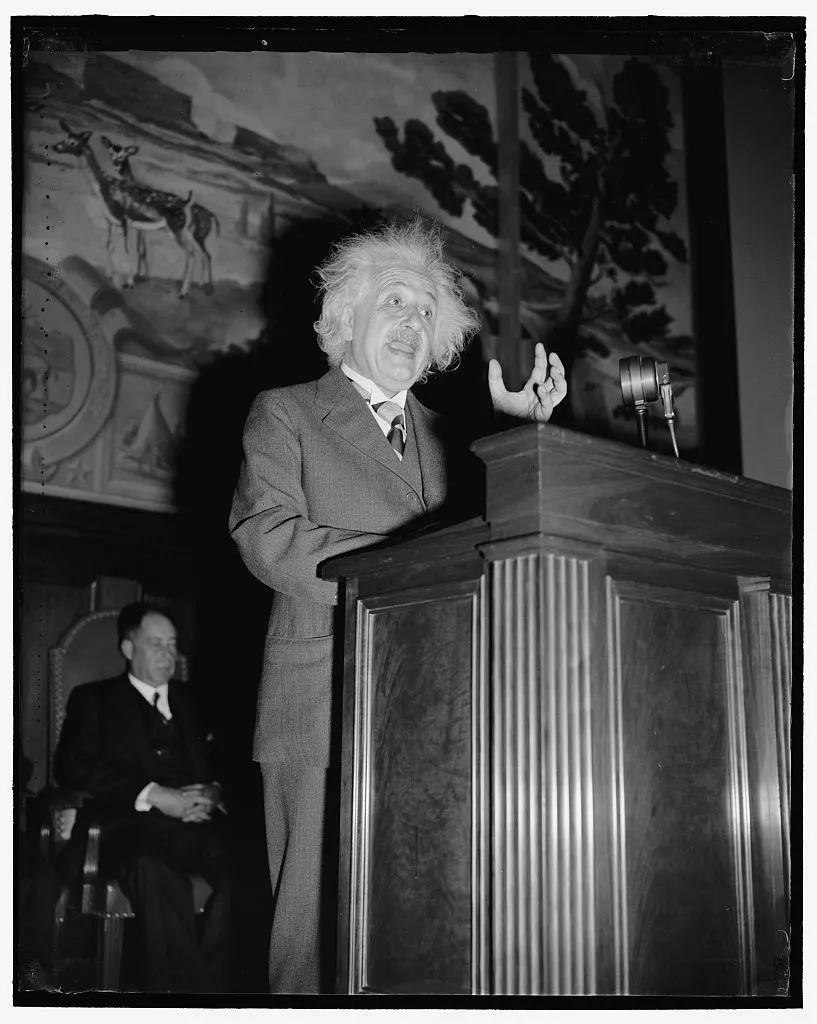
Albert Einstein earned international fame for his general theory of relativity, which was published 100 years ago. The landmark theory redefined how people thought about space, time and gravity, but in the last 20 years of his life, Einstein parlayed his public admiration into promoting causes outside of physics that were dear to his heart.
Most people know that Einstein was an anti-war activist, but after moving to the United States in 1933 and becoming a U.S. citizen, the iconic scientist also confronted American racism. According to the authors of "Einstein on Race and Racism," (Rutgers University Press, 2006), Einstein was keenly aware of the similarities between American segregation and the treatment of Jews in Germany.
Before moving to Princeton, New Jersey, Einstein was harassed and denounced by the Nazis. But when he got to his new hometown in the United States, he found that it was also strictly segregated, with separate schools and movie theaters for blacks and whites. And at the time, Princeton University wouldn't admit black students. [10 Historically Significant Political Protests]
Some of Einstein's most significant efforts for civil rights took place in 1946, a year in which a wave of anti-black violence swept the United States. African-American World War II veterans were attacked and lynched throughout America. Yet the mainstream media often ignored Einstein's speeches and writings on civil rights during this time, leaving little public record of his efforts.
While celebrating the general theory of relativity's 100th anniversary, it's also worth remembering Einstein's lesser-known advocacy work. Here are six ways Albert Einstein supported the civil rights movement in America.
Einstein receives his certificate of American citizenship.
(Image credit: Al Aumuller/Library of Congress)
1. Shortly before moving to America, Einstein backed a campaign to defend the Scottsboro Boys, nine Alabama teenagers who were falsely accused of rape in 1931.
2. When Princeton's Nassau Inn refused to rent a room to contralto opera star Marian Anderson because of her skin color, Einstein invited the singer home as his guest. Their friendship lasted from 1937 until his death in 1955, and Anderson stayed with the Einsteins whenever she visited Princeton.
Sign up for the Live Science daily newsletter now
Get the world’s most fascinating discoveries delivered straight to your inbox.
3. In 1946, Einstein gave a rare speech at Lincoln University in Pennsylvania, a historically black university, where he also accepted an honorary degree. The appearance was significant because Einstein made a habit of turning down all requests to speak at universities. During his speech, he called racism "a disease of white people."
4. Einstein was a friend and supporter of African-American actor and singer Paul Robeson, who was blacklisted because of his civil rights work. The pair worked together in 1946 on an anti-lynching petition campaign. In 1952, when Robeson's career had bottomed out because of the blacklisting, Einstein invited Robeson to Princeton as a rebuke to the performer's public castigation.
5. For decades, Einstein offered public encouragement to the National Association for the Advancement of Colored People (NAACP) and its founder, W. E. B. Du Bois. And in 1951, when the federal government indicted the 83-year-old Du Bois as a "foreign agent," Einstein offered to appear as a character witness during the trial. The potential publicity convinced the judge to drop the case.
6. In January 1946, Einstein published an essay, "The Negro Question," in Pageant magazine in which he called racism America's "worst disease." Here is an excerpt from that essay.
"There is, however, a somber point in the social outlook of Americans. Their sense of equality and human dignity is mainly limited to men of white skins. Even among these there are prejudices of which I as a Jew am clearly conscious; but they are unimportant in comparison with the attitude of the "Whites" toward their fellow-citizens of darker complexion, particularly toward Negroes. The more I feel an American, the more this situation pains me. I can escape the feeling of complicity in it only by speaking out…
Your ancestors dragged these black people from their homes by force; and in the white man's quest for wealth and an easy life they have been ruthlessly suppressed and exploited, degraded into slavery. The modern prejudice against Negroes is the result of the desire to maintain this unworthy condition."
Becky Oskin covers Earth science, climate change and space, as well as general science topics. Becky was a science reporter at Live Science and The Pasadena Star-News; she has freelanced for New Scientist and the American Institute of Physics. She earned a master's degree in geology from Caltech, a bachelor's degree from Washington State University, and a graduate certificate in science writing from the University of California, Santa Cruz.