













'Big Bang' of Species May Be Explained by Continental Shift

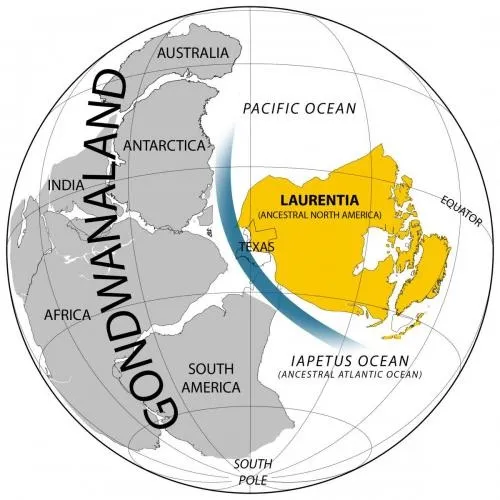
A sudden explosion of new life-forms hundreds of millions of years ago may have been triggered by a major tectonic shift, new research shows.
About 530 million years ago, the Cambrian explosion brought a surge in new species to Earth, including most modern animal groups. Recent studies suggest that, during the Cambrian explosion, life evolved about five times faster than it's evolving today. The sudden increase in species is sometimes referred to as "Darwin's dilemma" because, at face value, it seems to contradict Charles Darwin's theory of gradual evolution.
Scientists are still unsure what caused the number of species to skyrocket in such a short period of time, but Ian Dalziel, a research professor at the University of Texas Institute for Geophysics, thinks part of the answer may lie in how the continents shifted. [Photos: How North America Grew as a Continent]
Dalziel thinks the ancient continent Laurentia (present-day North America) remained attached to the fused supercontinent Gondwana longer than current reconstruction models suggest. Some current models suggest Laurentia had already broken off before the Cambrian period. Instead, Dalziel thinks a deep ocean developed between Laurentia and Gondwana during the early Cambrian period and that the tectonic shift and resulting ocean likely caused sea levels to rise.
"When you open a gateway of water like that, you displace water — like a body in a bathtub," Dalziel told Live Science.
The displaced water created new shallow-water environments that opened up new niches for new species to fill. The shifting continents also likely caused an upwelling of deep-ocean water that brought an influx of nutrients into shallow waters that allowed new life-forms to flourish, Dalziel said.
Dalziel also thinks Laurentia was once attached to what is now present-day Antarctica and South America, instead of what is now present-day Europe and Africa, as is widely believed. Part of the rock record in Antarctica that Dalziel studied suggests that North America broke off near the Ellsworth Mountains in Antarctica.
Get the world’s most fascinating discoveries delivered straight to your inbox.
But it's tricky to reconstruct ancient continental shifts. Researchers have to rely on paleomagnetism data. Paleomagnetism data shows up in some rock minerals that hold traces of Earth's magnetic field. The magnetic record shows how the field changes over time and the location of tectonic plates. Dalziel said it's easy to measure the latitude of tectonic plates based on these records, but it's much more difficult to measure longitude. Dalziel thinks the latitude predictions of Laurentia are correct but that the longitude is off. That means no one knows for sure when Laurentia separated from the supercontinent.
John Goodge, a professor of geology at the University of Minnesota, who was not involved in the research, said Dalziel's work is important because it combines paleomagnetic data with geologic records from five different continents.
"Often, those that study paleomagnetism don't pay close attention to geology," Goodge said. "They have these fixed data sets that they don't think can be wrong."
The problem with paleomagnetism, Dalziel said, is that the magnetic record can be overwritten as Earth's magnetic field changes, and it's difficult to tell which geologic period the magnetic data corresponds to.
Goodge noted that the study lacked a specific time sequence for when Laurentia broke off and began to drift. This raises questions about how quickly the tectonic shifts happened, and if the before-and-after shots of Laurentia in the study fit in with other geologic data. Both Goodge and Dalziel said more data are needed to further develop the idea.
The new study is published in the November issue of the journal Geology.
Follow Kelly Dickerson on Twitter. Follow us @livescience, Facebook & Google+. Original article on Live Science.
