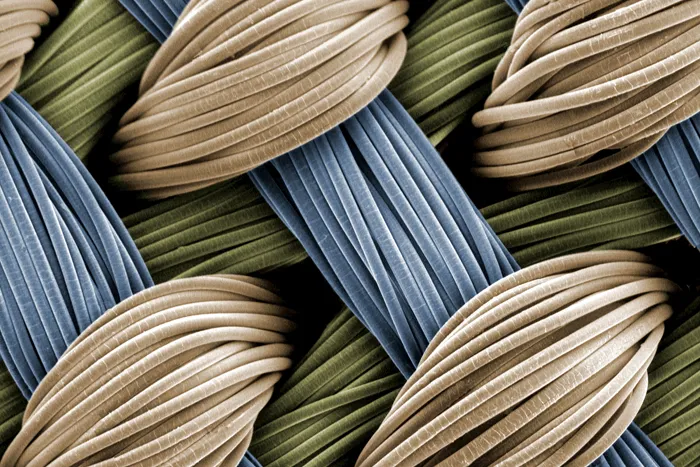
These tiny interwoven fibers make up a 3-D fabric scaffold that provides stability for a lubricating hydrogel and a framework for growing artificial cartilage.
(Image credit: This image appears on the cover of the Dec. 17, 2013, issue of Advanced Functional Materials. Photo courtesy of Frank Moutos and Farshid Guilak.
)
Humans and animals suffering from deteriorated articular cartilage — tissue that cushions bone joints — may one day find relief from the new synthetic material that mimics the suppleness and strength of natural cartilage tissue.
Articular cartilage is a durable, load-bearing tissue. Although it can withstand great stress while remaining lubricated enough to support thousands of joint movements, it wears away with overuse, injury or disease. Unfortunately, the uniqueness of this remarkable organic substance makes it difficult to replace.
Nevertheless, Duke University engineers Farshid Guilak and Xuanhe Zhao developed a flexible, durable tissue that can model the functionality of natural cartilage They created the synthetic tissue by uniting a 3-D fabric scaffold that Guilak and his team developed in 2007 with a hydrogel that Zhao and a team from Harvard University engineered in 2012. Hydrogels are composed of many molecule chains, called polymers, suspended in water. Just as a steel framework may provide stability for concrete poured over it, the 3-D fabric creates a lattice scaffold that provides stability for the malleable hydrogel.
Rigid clamps help demonstrate how stretchable the hydrogel is.
(Image credit: This image appears in the September 6, 2012 issue of Nature in the article, "Highly Stretchable and Tough Hydrogels." Photo courtesy of Zhigang Suo.)
Zhao’s resilient, lubricating hydrogel integrates with the durable fabric, resulting in a synthetic material that may be injected with stem cells and grown into articular cartilage tissue.
Sign up for the Live Science daily newsletter now
Get the world’s most fascinating discoveries delivered straight to your inbox.
While this new artificial tissue does not serve as an exact replica of natural articular cartilage, it is a highly advanced synthetic material. The technology proves that a functional biomaterial simulating the pliable support of joint cartilage can be produced in the laboratory. "From a mechanical standpoint, this technology remedies the issues that other types of synthetic cartilage have had," says Zhao. "It is a very promising candidate for artificial cartilage in the future."
Editor's Note: Any opinions, findings, and conclusions or recommendations expressed in this material are those of the author and do not necessarily reflect the views of the National Science Foundation. See the Research in Action archive.