













Cosmic Ray Quest: How Huge Telescope Array Works

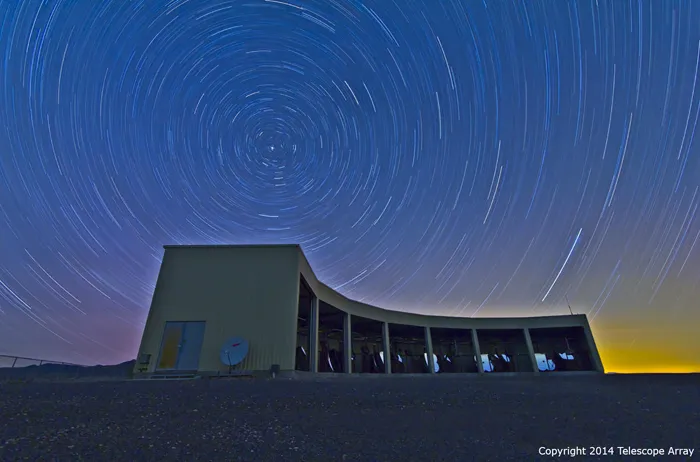
In a 300-square-mile (777 square kilometers) patch of desert west of Delta, Utah, hundreds of astronomical eyes have spent the last five years watching the heavens, looking for supercharged particles from deep in space.
The $25 million Telescope Array cosmic ray observatory was built to detect these high-energy visitors, known as cosmic rays, whose origin remains a mystery. The observatory is a joint venture of researchers from the University of Utah, in Salt Lake City, and from Japan, and is the largest such detector in the Northern Hemisphere.
The Telescope Array recently detected a cosmic ray hotspot in a region of the sky just beneath the Big Dipper. Researchers are unsure what could be producing such a disproportionate amount of the energetic radiation, but the discovery could help scientists understand how ultrahigh-energy particles in the universe are formed. [In Images: Utah's Cosmic Ray-Finding Telescope]
Cosmic visitors
Cosmic rays are high-energy subatomic particles — protons (hydrogen nuclei) or possibly helium or nitrogen nuclei. Ultrahigh-energy cosmic rays posses an energy above 1 billion billion electron volts, about as much energy as a baseball pitched by a good Little League player, said Gordon Thomson, a physicist at the University of Utah, who led the recent study. These particles have much more energy than anything that could be produced in a manmade particle accelerator, Thomson added.
Scientists suspect these ultrahigh-energy cosmic rays may originate in active galactic nuclei — black holes in the centers of galaxies — or possibly in supernovas, but no one knows for sure.
When a cosmic ray hits Earth's atmosphere, it interacts with the nucleus of a nitrogen or oxygen atom and "smashes it to smithereens," Thomson told Live Science. When this happens, these particles hit others, creating a shower of particles moving in the same direction as the cosmic ray.
Get the world’s most fascinating discoveries delivered straight to your inbox.
The Utah observatory has two kinds of detectors to spot these cosmic showers in the air or on the ground.
The telescope
The ground-based system consists of 523 "scintillation counters" that detect the particle showers as they hit Earth in the shape of a flattish pancake, Thomson said. As the particles go through the detectors, they give off a burst of light that is converted into electricity. Researchers use this information to reconstruct a cosmic ray's trajectory.
Another system of telescopes tracks the particle showers as they fly through the air. As one of these particles moves through the atmosphere, it "excites" nitrogen molecules in its path, which then fluoresce, or give off radiation, in ultraviolet wavelengths that are outside the range of human vision. A set of large mirrors detects this fluorescence by focusing the light onto a camera made of ultraviolet detectors. As the shower moves through the atmosphere, the image moves across several detectors.
Compared with the ground-based arrays, the fluorescence telescopes provide a much more dynamic picture of the cosmic rays, instead of only a snapshot of a shower, Thomson said. But the advantage comes with a price: These detectors can only be used at night when the moon isn't up — only about 10 percent of the time — because sunlight or moonlight would drown out the particle showers, Thomson said.
When both detectors are used together, however, it provides a much more complete picture of each cosmic ray and where it came from.
Today's observatory grew out of two previously competing facilities: the University of Utah's Fly's Eye fluorescence observatory, and a ground-based detector system developed in Japan. The two groups collaborated to build the Telescope Array, which became operational in 2008.
The observatory is planning to double the number of its ground-based detectors, to about 1,100, spanning an area more than 1,150 square miles (3,000 square kilometers). The expansion would allow scientists to detect many more cosmic ray events, and allow them to determine, for example, whether the newly discovered cosmic ray hotspot came from one source or many. "Everything now depends on statistics," Thomson said.
Follow Tanya Lewis on Twitter and Google+. Follow us @livescience, Facebook & Google+. Original article on Live Science.
