













Fool's Gold Preserves Skin and Hair Fossils

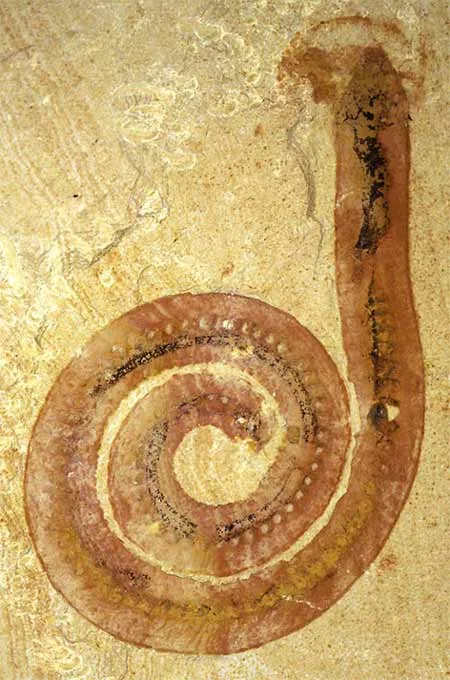
Dentists use gold inlays to save rotting teeth. Nature uses the fool's variety to save rotting flesh.
Commonly known as fool's gold, pyrite deposits have preserved the soft tissues, such as hair and skin, of animals that died 500 million years ago in the Chengjiang sediments of China.
Unlike most fossils, which are remnants of bone, the pyrite replaced soft tissues that were being gobbled up by decay-causing bacteria.
"When an animal dies, bacteria eat the 'squishy parts' of the corpse, and they give off hydrogen sulfide," said Sarah Gabbott of the University of Leicester in England.
Typically, the hydrogen sulfide gas leaks out of the decomposing matter, but if iron is present, as in the case of Chengjiang, crystals of pyrite can form the combination.
"The bacteria that are decaying the animal are helping to preserve it by allowing pyrite to precipitate," Gabbott said.
The pyrite later rusts, leaving a reddish-orange outline of an organism's soft tissues. Gabbott and her colleagues describe in a recent issue of Geology how this pyrite mechanism helped produce the wealth of fossils at Chengjiang.
Get the world’s most fascinating discoveries delivered straight to your inbox.
"Although these animal remains are over 500 million years old nearly every detail of their anatomy can be studied, from the spiny proboscis of ancient worms to the hairs on the legs of primitive arthropods," Gabbott said.
Gabbott explained that these details had to be recorded quickly. The bacteria will devour the softest parts, like organs and skin, of an organism in a matter of days. Some of the tougher parts, like hair, will take the bacteria slightly longer to consume.
The scientists realized that the decomposition rate affects the type of pyrite crystals that form. If the process is rapid, the pyrite ends up in raspberry shaped clumps. At a slower pace, the crystals display octahedral and cubic patterns.
Knowing the kind of tissue implied by a Chengjiang fossil will help understand the unique life forms that swam in the shallow sea that covered this region during the Cambrian period. This was a time of rapid species development, and Chengjiang, which was discovered in 1984, captures a lot of the changes - including the earliest known fish.
"The reason Chengjiang is so amazing is it preserved animals from an important evolutionary period when multi-cellular life really got going," Gabbott said.
Some of the fossils are very strange and are therefore difficult to classify. Gabbott hopes to use the new understanding of how the soft tissue fossils formed to figure out where they belong in the web of life.
