













How Wolf Packs Organize to Kill
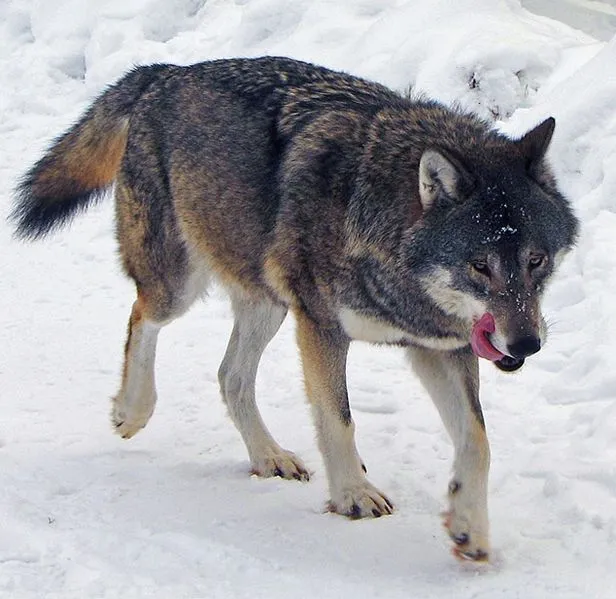
The way that wolves organize themselves into hunting packs depends upon the number of participating wolves and the social status of each wolf, suggests a new study in the Journal of the Royal Society Interface.
The methods show a striking resemblance to human-run businesses, which serve as another example of animal cooperation to meet a presumably shared goal. In the case of wolves, that goal is to kill other animals for survival.
There are benefits and drawbacks to such cooperation, however, as the authors point out.
“The cooperation of multiple hunters presumably sometimes allows them to successfully capture prey that none of them would be able to capture on their own,” Ramón Escobedo of the AEPA Euskadi, and his colleagues wrote. “This is the benefit of cooperation. On the other hand, those hunting together have to share their spoils; this is the cost of cooperation.”
When hunting prey, such as elk, the best number of organized wolves is four or five. Escobedo and his team share that the wolves can then form “a regular polygon” around the victim. Once surrounded, the victim has little chance of escaping, given the fast moves and steely sharp teeth of wolves.
This type of pack is also successful because each wolf participant gets a nice share of the meat reward, sustaining them and motivating them to work hard during the next hunt.
Get the world’s most fascinating discoveries delivered straight to your inbox.
Computer modeling determined that wolf hunting parties larger than four or five look surprisingly like a socially structured group. The researchers suspect that the following scenario could explain one of these larger packs:
“A breeding pair stands (almost) still in the inner orbit, leading or conducting the hunt, while four inexperienced offspring move back and forth from the inner orbit to the outer and vice versa, and a single excited juvenile remains protected behind its progenitors.”
Dogs Not as Close Kin to Wolves as Thought
The young wolf, like a kid taken to a parent’s career day, then gets to learn by watching while remaining in a mostly passive, safe position.
The inclusion of younger, inexperienced wolves could benefit the pack in the long run, but in the short run, bringing in such participants can be a burden on the hard-working older wolves that now have to share their kills, earning less meat themselves.
Sound familiar? Businesses often force their workers to suffer similar growing pains for the sake of the company’s positioning and not for the sake of the individual participants.
Interestingly enough, prior studies on jackals, coyotes and African wild dogs also conclude that “small groups provide the optimal ratio of benefit-to-cost,” according to the paper. Many small business proponents would likely agree.
The researchers add, however, that larger animal groups organized for hunts reduce the loss of food to scavengers.
Escobedo and his team believe that complex collective behaviors can emerge from what starts off as a relatively simple situation. For wolves, that simple goal is how to best kill prey. The larger the number of wolves that participate in that effort, the more significant social organization becomes.
This story was provided by Discovery News.