













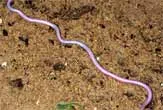
A rare blind snake has been rediscovered in Madagascar a century after its last sighting. The snake, which looks like a long, skinny pink worm, was only known from two other specimens, both discovered in 1905.
“They’re really rare because they’re subterranean,” said blind-snake expert Van Wallach of Harvard University who described the new specimen. “You can’t just go out anytime you want and collect these things. You can dig forever and never find them.”
Scientists captured the snake [image], called Xenotyphlops mocquardi, alive in 2005 during an expedition to collect reptiles and amphibians in northern Madagascar. The specimen was approximately 10 inches long and about as thick as a pencil.
There are about 15 species of blind snakes on the island, so the unique nature of the team’s find wasn’t apparent until the blind snake specimen was sent to museum experts for identification and possible comparison with dead specimens in their collections.
“They sent it to me and I immediately recognized what it was,” Wallach told LiveScience.
Vincenzo Mercurio, a scientist on the expedition that discovered the snake, said he didn’t think anything special about the catch at the time. “It was just routine field work,” said Mercurio, who is from the Forschungsinstitut und Naturhistorisches Museum Senckenberg in Germany.
Blind snakes, as their name suggests, have poor vision.They hunt mainly by smell, which they detect via a combination of their tongues and an organ located on the roof of their mouths called Jacobson’s organ.
Get the world’s most fascinating discoveries delivered straight to your inbox.
“They basically see shadows and back and forth movements,” Wallach said.
Blind snakes, and a related group, called worm snakes, live underground or beneath a layer of rocks or sand. The two snake families are negatively phototaxic, meaning they avoid light whenever possible.
“If you catch one or bring it to the surface, it immediately wants to crawl under something or crawl down into the ground,” Wallach said.
Blind and worm snakes are the only snakes that dine solely on insects. They feed on the eggs, larvae and pupae of ants and termites, Wallach said.
Scientists believe the two groups separated from a common ancestor sometime during the Cretaceous period, when their larger reptilian cousins, the dinosaurs, still walked the Earth.
Blind snakes can sometimes appear to be sighted. “Most blind snakes and worm snakes do have eyes, but they’re vestigial," Wallach said. "Sometimes they’re only little black spots, sometimes they‘re well developed enough to have a pupil and an iris, but they’re very, very tiny.”
The rediscovered blind snake is detailed in the Feb. issue of the journal Zootaxa.
- The Strangest Animal Discoveries of 2006
- Fear of Snakes Drove Pre-Human Evolution
- Startling Discovery: The First Human Ritual
- Race Fears Linger Like Dread of Snakes
- Night Lights Mean Lights-Out for Snakes