













Mystery Solved: Why Rhino Horns are Curved and Pointed

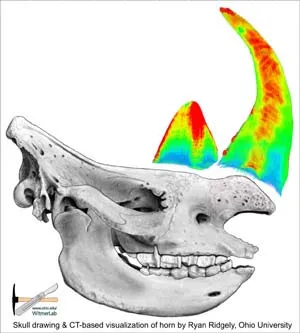
Scientists have never understood why rhinoceros horns are curved and pointed. A new study reveals why.
The horns of most animals have a bony core covered by a thin sheath of keratin, the stuff of hair and fingernails. But rhino horns are unique, being made entirely of keratin.
Using CT scans, researchers at Ohio University found dark patches in the centers of the horns. These dense mineral deposits are made of calcium and melanin [image]. The calcium makes the core of the horn harder and stronger, and the melanin protects the core from breakdown by the sun's UV rays, the scientists conclude.
The structure is similar to a pencil, which has a tough core and a weaker layer of wood that can be shaped easily into a point.
The outer part of a rhino horn is degraded by the sun and worn to a point when the beasts clash horns with one another and by being rubbed on the ground and whatever else rhinos rub their horns on. If they never used them, the horns would look more like cylinders.
So why do the horns curve?
"Because the keratin in the front grows a little bit faster than the keratin in the back," said study leader Tobin Hieronymus, an OU doctoral student. "Most rhino horns curve backwards, but every now and then you'll see one that curves forward. Some of them even change curve directions halfway up, all from slight differences in growth rate."
Get the world’s most fascinating discoveries delivered straight to your inbox.
Fingernails will curve for the same reason, if you grow them long enough, Hieronymus told LiveScience.
The study ends speculation that rhinoceros horns were just clumps of modified hair, Hieronymus and colleagues say. "The horns most closely resemble the structure of horses' hoofs, turtle beaks and cockatoo bills," he said.
The research was published in the October issue of the Journal of Morphology.
- World's Ugliest Animals
- Rare Borneo Rhino Photographed for First Time
- Surprising Twists Found in Triceratops Horns
- Mystery of 'Unicorn' Whale Solved
- The World's Biggest Beasts

Robert is an independent health and science journalist and writer based in Phoenix, Arizona. He is a former editor-in-chief of Live Science with over 20 years of experience as a reporter and editor. He has worked on websites such as Space.com and Tom's Guide, and is a contributor on Medium, covering how we age and how to optimize the mind and body through time. He has a journalism degree from Humboldt State University in California.