













Skull Images May Help Solve Cold Cases

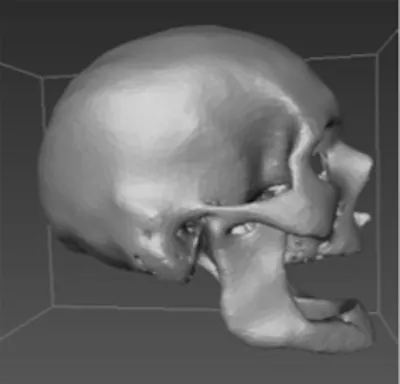
Skull scans of the living might one day help forensic anthropologists solve cold cases, a new study suggests.
When little other data is available, certain features on skulls can sometimes help anthropologists piece together the identity of a nameless person —whether they were a man or woman, and perhaps even their heritage. With unidentified remains in mind, a group of researchers developed software called 3D-ID to compare digital skull maps to a database of biological characteristics.
"That comparison can tell us the ancestry and sex of unidentified remains using only the skull — which is particularly valuable when dealing with incomplete skeletal remains," Ann Ross, a professor of anthropology at North Carolina State University, said in a statement. [In Photos: 'Alien' Skulls Reveal Odd, Ancient Tradition]
However, Ross and colleagues have been limited in their approach, because they have little access to modern skulls that have clear demographic records. So they set out to investigate whether X-ray computed tomography scans, or CT scans, from living people could be just as useful as digital maps of dry skulls.
The team obtained 48 CT scans of skulls from a rather controversial collection that was compiled in the 19th century by infamous anthropologist Samuel George Morton and is today housed at the University of Pennsylvania Museum. (Morton took measurements of skulls to determine whether different populations of humans actually constituted different species, and he is notorious for his idea that race determined intellectual ability.)
The researchers compared the CT scans of Morton's skulls with their own manual maps of the skulls, drawn with an electronic stylus and found that bilateral coordinates on the skulls (the features on both sides, such as the cheekbones) were consistent. The results suggest that CT scans, which are often used to diagnose medical problems, might be incorporated into their data set of skulls.
"This will allow us to significantly expand the 3D-ID database," Ross said. "And these bilateral coordinates give important clues to ancestry, because they include cheekbones and other facial characteristics."
Get the world’s most fascinating discoveries delivered straight to your inbox.
The team did, however, find inconsistencies between the CT scans and digital maps at the midline coordinates, or the points down the middle of the skulls, such as the bridge of the nose.
"More research is needed to determine what causes these inconsistencies, and whether we'll be able to retrieve accurate midline data from CT scans," study leader Amanda Hale, a former NC State student, said in a statement.
The research was detailed in this month's issue of the Journal of Craniofacial Surgery.
Follow Megan Gannon on Twitter and Google+. Follow us @livescience, Facebook & Google+. Original article on LiveScience.
