













Dyson Spheres: How Advanced Alien Civilizations Would Conquer the Galaxy (Infographic)

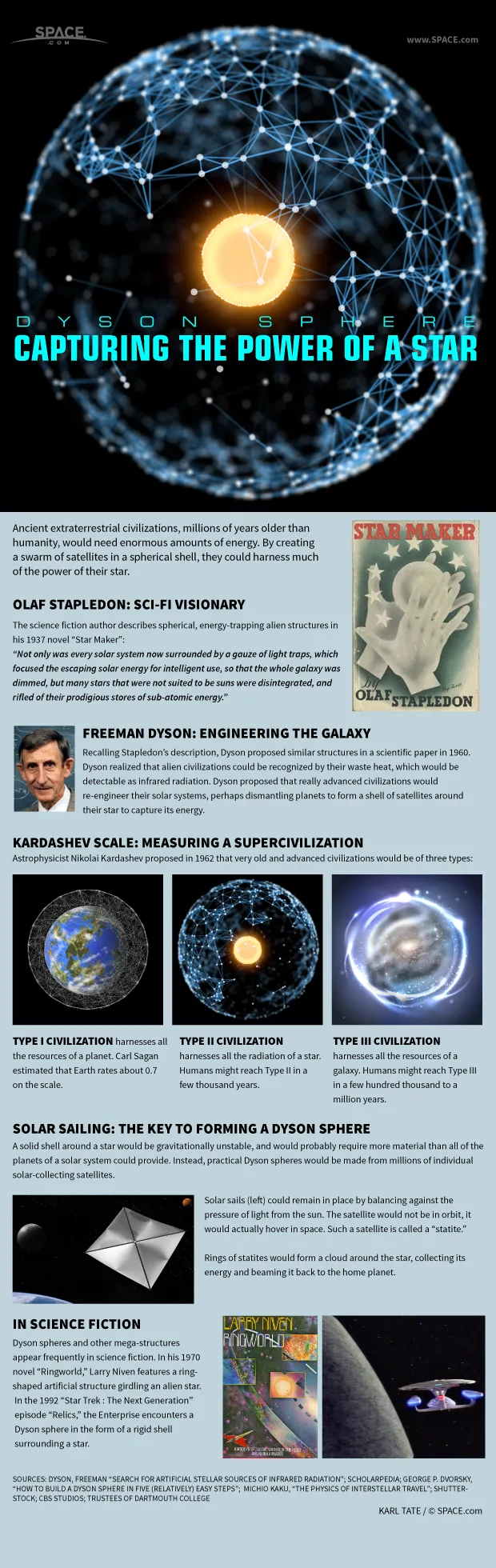
Ancient extraterrestrial civilizations, millions of years older than humanity, would need enormous amounts of energy. By creating a swarm of satellites in a spherical shell, they could harness much of the power of their star.
Science fiction author Olaf Stapledon described spherical, energy-trapping alien structures in his 1937 novel "Star Maker":
"Not only was every solar system now surrounded by a gauze of light traps, which focused the escaping solar energy for intelligent use, so that the whole galaxy was dimmed, but many stars that were not suited to be suns were disintegrated, and rifled of their prodigious stores of sub-atomic energy."
Incredible Technology: How to Search for Advanced Alien Civilizations
Recalling Stapledon's description, physicist Freeman Dysonproposed similar structures in a scientific paper in 1960. Dyson realized that alien civilizations could be recognized by their waste heat, which would be detectable as infrared radiation. Dyson proposed that really advanced civilizations would re-engineer their solar systems, perhaps dismantling planets to form a shellof satellites around their star to capture its energy. [13 Ways to Hunt Intelligent Aliens]
Astrophysicist Nikolai Kardashev proposed in 1962 that very old and advanced civilizations would be of three types:
A Type I civilization harnesses all the resources of a planet. Carl Saganestimated that Earth rates about 0.7 on the scale.
Get the world’s most fascinating discoveries delivered straight to your inbox.
A Type II civilization harnesses all the radiation of a star. Humans might reach Type II in a few thousand years.
A Type III civilization harnesses all the resources of a galaxy. Humans might reach Type III in a few hundred thousand to a million years.
A solid shell around a star would be gravitationally unstable, and would probably require more material than all of the planets of a solar system could provide. Instead, practical Dyson sphereswould be made from millions of individual solar-collecting satellites.
Solar sails could remain in place by balancing against the pressure of light from the sun. The satellite would not be in orbit, it would actually hover in space. Such a satellite is called a "statite." Rings of statites would form a cloud around the star, collecting its energy and beaming it back to the home planet.
Dyson spheres and other mega-structures appear frequently in science fiction. In his 1970 novel "Ringworld," Larry Niven features a ring-shaped artificial structure girdling an alien star. In the 1992 “Star Trek: The Next Generation” episode "Relics," the starship Enterpriseencounters a Dyson sphere in the form of a rigid shell surrounding a star.
· The Most Famous Astronomers of All Time
· The Top 10 Star Trek Technologies
Follow us @Spacedotcom, Facebook or Google+.
