













High Tides Trigger Earthquakes
The weight added by water at high tide can trigger movement close to land in earthquake faults that are already active, according to new global analysis.
"The importance of this work is to understand what stresses are needed to trigger a fault and this is one step of many that are needed to do that," Elizabeth Cochran, the lead author of the study told LiveScience. The study looked at data, taken from a Harvard database, of 2,000 earthquakes with magnitudes of 5.5 or higher in places where one piece of Earth's crust dives beneath another.
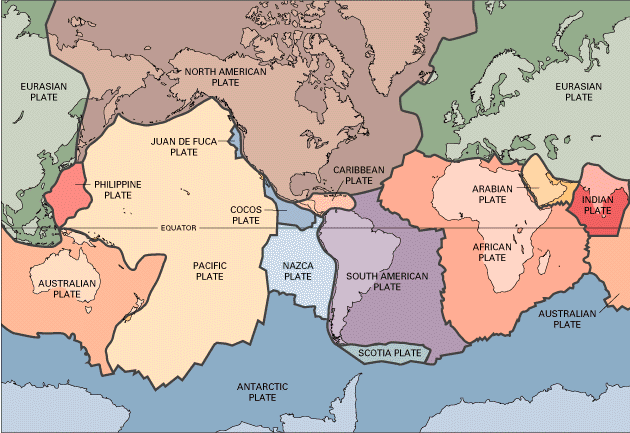
The surface of the Earth is not unbroken; rather it is divided into several large plates that move around on top of the planet. Wherever these plates come together there are faults. When a piece of ocean crust runs into a piece of continental crust, it is pushed beneath the lighter continent. Pressure builds. The release of pressure along a fault is what makes earthquakes.
The faults examined for the study, detailed recently in the online version of the journal Science, were near the surface and not far offshore, so that tides provide an increase and decrease in pressure due to the amount of water covering them.
"Large tides have a significant effect in triggering earthquakes," Cochran said. "The earthquakes would have happened anyway, but they can be pushed sooner or later by the stress fluctuations of the tides."
Because of gravity, the side of the Earth closest to the moon has a bulge of water. As our planet rotates the water on the opposite side, furthest from the gravity of the moon, essentially attempts to escape Earth's surface and creates a second high tide.
Another example of this force, called inertia, is how you feel when a car speeds around a corner. Although the car is going in a different direction, you are thrown against the door because your body is trying to continue in the same direction as before. On the remaining two sides, the forces of gravity and inertia even out and the water is neither trying to escape nor being pulled toward the moon, resulting in low tides.
Get the world’s most fascinating discoveries delivered straight to your inbox.
A computer program developed by co-researcher Professor Sachiko Tanaka models how the Earth responds to the Moon and the addition of water weight, as well as a model of the ocean floor.
"The program is an important part and why only in the last few years have we been able to do this (research)," Cochran said. "This is the first study that has been able to take into account the amplitude of the tides."
Cochran said larger tides have a higher chance of triggering an earthquake on an active shallow fault near land, compared with regions where tides are less severe.