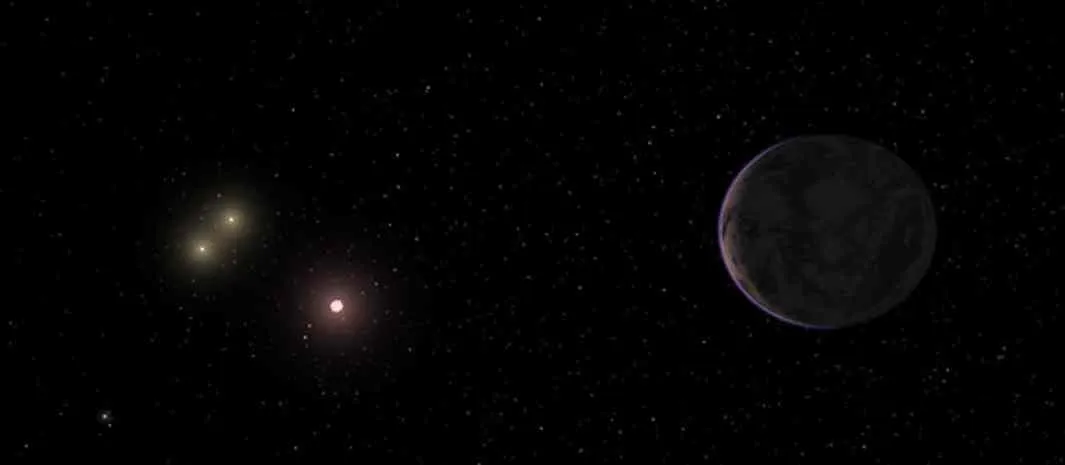
Finding alien life on habitable planets around distant stars may be harder to identify than scientists have previously thought, a new study suggests.
The search for inhabited and habitable exoplanets is focused on M dwarf stars — stars that are smaller than the sun but make up more than 75 percent of the stars in the sun's vicinity, scientists have said.
But these small stars have different ultraviolet properties from the sun, however, which could further complicate the search for alien life, researchers with the new study, which was unveiled today (Oct. 7).
"Before we can claim the discovery of life on exoplanets, we have to examine the stars harboring these planets more carefully," study leader Feng Tian, a professor at the Center for Earth System Science at Tsinghua University in Beijing, China, said in a statement. He presented the research today in Denver, Colo., at the 45th annual meeting of the American Astronomical Society's Division for Planetary Sciences.
The buildup of high levels of oxygen in the atmosphere of an exoplanet is the most promising indicatory for life on alien planets, officials from Tsinghua University said. The new study shows that oxygen can still build up in the atmospheres of lifeless planets, they added.
This graphic shows the orbits of the alien planet GJ 667Cc, which takes about 28 days to orbit its parent star. The orbits of other potential planets in the system are also shown.
(Image credit: Carnegie Institution for Science)
Feng Tian and his research team used the idea of a hypothetical habitable planet orbiting GJ 876 to test this in an earlier study. "In this case the atmosphere of a lifeless planet can be close to that of the Earth's 2.2 billion years ago, after the so called Great Oxidation Event in Earth's geological history," he said.
The new study also suggests that these earlier findings can be extrapolated out to other alien planets circling M dwarf stars, researchers said. The team collected ultraviolet data from GJ 667C — a star that plays host to three possibly habitable planets — and three other M dwarfs for the new work.
Sign up for the Live Science daily newsletter now
Get the world’s most fascinating discoveries delivered straight to your inbox.
"Prof. Feng Tian's research addresses one of the most important questions of contemporary astrophysics and indeed of great interest to the general public: Are there other habitable planets near Earth, and is there any evidence that they are indeed inhabited?" Jeffrey Linsky of the University of Colorado at Boulder, said in a statement.
Miriam Kramer joined Space.com as a staff writer in December 2012. Since then, she has floated in weightlessness on a zero-gravity flight, felt the pull of 4-Gs in a trainer aircraft and watched rockets soar into space from Florida and Virginia. She also serves as Space.com's lead space entertainment reporter, and enjoys all aspects of space news, astronomy and commercial spaceflight. Miriam has also presented space stories during live interviews with Fox News and other TV and radio outlets. She originally hails from Knoxville, Tennessee where she and her family would take trips to dark spots on the outskirts of town to watch meteor showers every year. She loves to travel and one day hopes to see the northern lights in person.