













Diving Marine Animals Guzzle Oxygen from Ocean

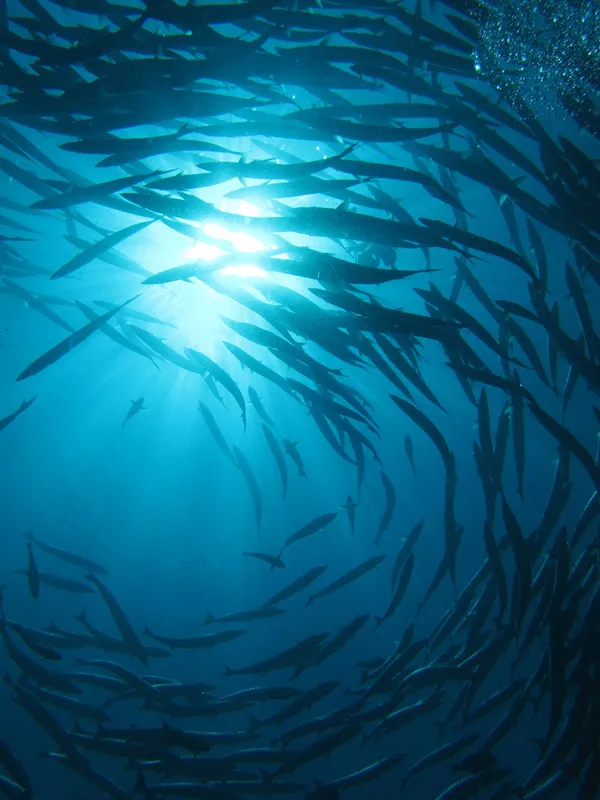
Marine animals swim to astonishing depths each day, diving for food and hiding from predators. These movements may seem miniscule against the enormity of the ocean, but combined on a global scale, they actually alter the ocean's oxygen levels, new research shows.
Until now, marine scientists had assumed that microbes and other tiny, ubiquitous organisms controlled ocean oxygen fluctuations: As these microscopic life-forms die near the surface of the ocean, they sink and slowly degrade — a process that uses up oxygen. But researchers at Princeton University in New Jersey and McGill University in Montreal have found that migrations of animals to the ocean surface at night — when darkness makes them less vulnerable to predators — also plays an important role in oxygen levels, they reported earlier this month in the journal Nature Geoscience.
"You can say that the whole ecosystem does this migration — chances are that if it swims, it does this kind of migration," study co-author Daniele Bianchi, an oceanographer at McGill University, said in a statement. "Before, scientists tended to ignore this big chunk of the ecosystem when thinking of ocean chemistry. We are saying that they are quite important and can't be ignored."
Bianchi's team compiled acoustic data collected from oceanographic vessels over the course of two decades, from 1990 to 2011, to assess where and when a variety of ocean animals tend to congregate throughout the day. They then modeled these data against global records of ocean oxygen levels, and found that areas of low oxygen often aligned with areas of animal migration.
This apparent correlation between low oxygen levels and migration is likely a two-way system, the team reports. Animals likely seek out deep, oxygen-deprived regions in order to avoid predators during the day, and as they congregate, they further deplete oxygen levels.
"In a sense, this research should change how we think of the ocean's metabolism," Bianchi said. "Scientists know that there is this massive migration, but no one has really tried to estimate how it impacts the chemistry of the ocean."
Next, the researchers plan to more closely explore migrations and ocean oxygen levels at specific locations in an effort to better understand how this global phenomenon varies on a local scale.
Get the world’s most fascinating discoveries delivered straight to your inbox.
Follow Laura Poppick on Twitter. Follow us @livescience, Facebook & Google+. Original article on LiveScience.com.
