














Why Do People Talk In Their Sleep?

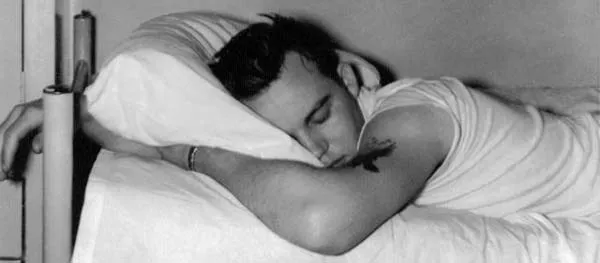
Almost all of us have at some point been told that we were talking in our sleep the night before. It can be a disturbing thing to hear. "Did I say anything embarrassing?" we might wonder, or, "Did I spill the beans?" There's also the possibility that our words revealed some deep subconscious desire of which we are normally unaware. In any case, we are morbidly curious: "What did I say?"
Usually, nothing interesting. Studies have found that most sleep speeches are brief, nonsensical utterances lasting just one or two seconds rather than noteworthy ruminations.
Sleep talking, also known as somniloquy, may occur during both the REM (rapid eye movement) and non-REM sleep phases. When it happens during REM sleep — the stage during which we dream — it's caused by "motor breakthrough" of dream speech: One's mouth and vocal cords, usually inactive when we're sleeping, briefly get switched on, and words spoken by one's character in a dream are spoken out loud. Sleep talking may also occur during "transitory arousals," when a sleeper becomes half-awake while transitioning from one stage of non-REM sleep to another. In both cases, it happens when certain aspects of wakefulness intrude during our sleep time, allowing us to talk (but preventing us from making much sense).
It's hard to gauge how common it is for people to talk in their sleep, because we usually sleep through the experience, and (unless we're screaming) so do our bedfellows. Estimates vary, but studies have found that more than half of children probably deliver the occasional somniloquy, and the behavior becomes less common as we age. Other types of parasomnia, such as sleepwalking and teeth grinding, follow the same pattern. Chronic sleep-talking in adulthood is considered to be a sleep disorder, and may result from stress and other factors. [What Do Babies Dream About?]
Because sleep-talking occurs during momentarily overlapping states of consciousness, it usually lasts just one or two seconds. The sleep psychologist Arthur Arkin once wrote that sleep-talkers' sudden, out-of-the-blue vocal outbursts, which are immediately followed by a return to silent sleep, "reminds one of a seal swimming under water, surfacing for a cordial, peremptory, or meditative bark and deftly resubmerging."
Rare examples of sleep speeches hundreds of words long have been recorded, however. They're usually gibberish, but even eloquent somniloquy — confessions of wrongdoing, for instance — shouldn't be taken literally. According to the National Sleep Foundation, science and the law both consider sleep speech not to be the product of a conscious or rational mind, and it is therefore inadmissible in court.
Follow Natalie Wolchover on Twitter @nattyover. Follow Life's Little Mysteries on Twitter @llmysteries, then join us on Facebook.
Feed your curiosity with an exclusive mystery every week, solved with science and delivered direct to your inbox before it's seen anywhere else.

Natalie Wolchover was a staff writer for Live Science from 2010 to 2012 and is currently a senior physics writer and editor for Quanta Magazine. She holds a bachelor's degree in physics from Tufts University and has studied physics at the University of California, Berkeley. Along with the staff of Quanta, Wolchover won the 2022 Pulitzer Prize for explanatory writing for her work on the building of the James Webb Space Telescope. Her work has also appeared in the The Best American Science and Nature Writing and The Best Writing on Mathematics, Nature, The New Yorker and Popular Science. She was the 2016 winner of the Evert Clark/Seth Payne Award, an annual prize for young science journalists, as well as the winner of the 2017 Science Communication Award for the American Institute of Physics.