













Who Was the First Person to Fly?

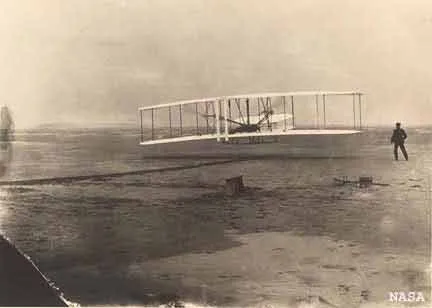
Orville and Wilbur might jump to mind. But the Wright Brothers were half a century late.
Lots of pioneers risked their necks over many decades (and even centuries) to get humans off the ground by various means, from flapping their pseudo-wings to gliding off cliffs.
Still, few are remembered so well or mentioned so often as the Wright Brothers, whose "Flying Machine" was the first powered airplane to execute controlled and sustained flight. They did it on Dec. 17, 1903. The pilot was Orville, since Wilbur had taken his turn in a failed previous attempt. The Wright Flyer was in the air for 12 seconds and went 120 feet.
But this was not the first human flight.
Modern flight began in 1783 when Joseph-Michael and Jacques-Ètienne Montgolfier engineered the first hot-air balloon flights. On Oct. 15, 1783, the Montgolfiers brothers launched a balloon on a tether with Jean-François Pilâtre de Rozier, a chemistry and physics teacher, as the passenger. In that era, nobody knew if a person could withstand the rigors of being up in the air, so a previous flight had included animals, to see if they survived. They did, as did de Rozier. Later that year, the first untethered flight was made.
The Wright Brothers' achievement is sometimes erroneously called "the first powered flight." Even that's disputed.
The first powered flight was Henri Giffard's steam-powered airship (image below) in 1852. On Sept. 24, 1852, Giffard traveled almost 17 miles (27 kilometers) from Paris to Trappes moving at about 6 miles per hour (10 kilometers/hour). His airship could be steered only in calm weather, though. In wind, it could fly only in slow circles.
Get the world’s most fascinating discoveries delivered straight to your inbox.
Clément Ader went half the length of a football field in a bat-winged setup that many view as the first manned, powered, heavier-than-air flight in 1890.
The Wright Brothers achievement is properly called "the first manned, powered, heavier-than-air and (to some degree) controlled" flight.
Follow Life's Little Mysteries on Twitter @llmysteries. We're also on Facebook & Google+.

Robert is an independent health and science journalist and writer based in Phoenix, Arizona. He is a former editor-in-chief of Live Science with over 20 years of experience as a reporter and editor. He has worked on websites such as Space.com and Tom's Guide, and is a contributor on Medium, covering how we age and how to optimize the mind and body through time. He has a journalism degree from Humboldt State University in California.