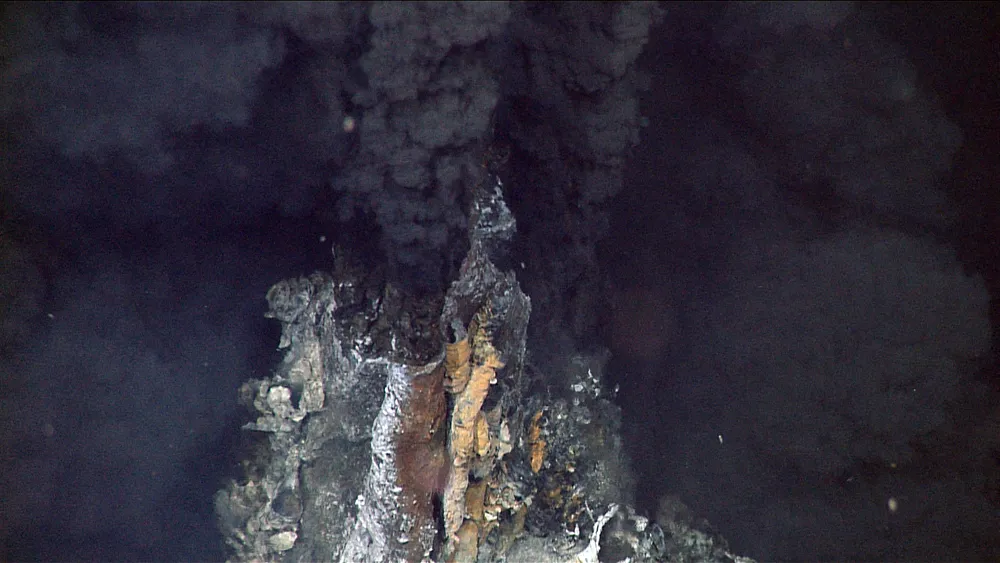
Scientists have uncovered clusters of volcanic vents towering above the seafloor in a region of the deep sea off the coast of Mexico.
The formations are home to a bizarre menagerie of creatures that thrive in the blistering heat and total darkness of these magma-powered hydrothermal vents, which are essentially fissures and cracks in the ocean floor that allow seawater to reach deep, superheated rocks, producing scalding jets of chemical-laden water.
The so-called "black smoker" vents lie about 7,900 feet (7,400 meters) deep; the loftiest of the "chimneys" is 75 feet (23 meters) tall.
Researchers with the Monterey Bay Research Institute (MBARI) discovered these vent fields in late April, at the tail end of a three-month expedition to the Gulf of California, the narrow finger of ocean that separates mainland Mexico from the Baja Peninsula.
The vents lie near the tip of the peninsula along the Alarcón Rise, a seafloor spreading center, where tectonic forces are shoving magma up toward the seafloor along a volcanic seam, birthing fresh ocean crust and pushing two oceanic plates apart.
MBARI's David Clague, a volcanologist who led the expedition, had been hunting for hydrothermal vents in the region since 2003, when he and his colleagues first found chemical signatures in the water that indicated hydrothermal vents could be lurking nearby.
On this sonar-made map, the hydrothermal vents, marked by a yellow circle, can be clearly seen rising above the seafloor.
(Image credit: (c) 2012 MBARI)
Needle in a haystack
Sign up for the Live Science daily newsletter now
Get the world’s most fascinating discoveries delivered straight to your inbox.
"The usual method involves some luck, or investment of a lot of dive time, until you stumble onto the vents," Clague told OurAmazingPlanet in an email. This time the scientists had a robot on their side — and it was the key to the discovery.
A week ahead of their dive, the team sent out a free-roaming, deep-diving robot equipped with sonar. The robot brought back a detailed seafloor map that revealed tall, slim structures rising out of the seafloor — hydrothermal vents?
Next, using a remote-control robot equipped with a suite of instruments, the team set out to investigate.
"We had the maps that showed these tall chimneys, and as we approached the bottom, we observed a layer in the water that was murky, so we knew there were active chimneys nearby," Clague said. "Everyone on board was excited to see what we would find."
These tube worms, over three feet tall, live off the "smoke" particles from the vent.
(Image credit: (c) 2012 MBARI)
Life abounds
Right away, their search was rewarded.
"We encountered tube worm clumps and dead clamshells almost immediately, and from then it was just amazing," Clague said. [Images of the hydrothermal vents.]
The team took samples of the animals living near the vents: tube worms that can grow to more than 5 feet (1.5 meters) long, clams up to 10 inches (25 centimeters) across, and other weird creatures that survive on the vents' volcano-powered chemical soup.
The researchers also measured temperatures as high as 572 degrees Fahrenheit (300 degrees Celsius), although there are indications the vent fluids could be hotter than 660 F (350 C).
The new sonar mapping technique offers great promise for tracking down other hydrothermal vents on the seafloor, which increasingly appear to be more plentiful in the world's oceans than once thought.
Reach Andrea Mustain at [email protected]. Follow her on Twitter @AndreaMustain. Follow OurAmazingPlanet for the latest in Earth science and exploration news on Twitter @OAPlanetand on Facebook.
Andrea Mustain was a staff writer for Live Science from 2010 to 2012. She holds a B.S. degree from Northwestern University and an M.S. degree in broadcast journalism from Columbia University.